

Website Impressions High but Clicks Low? AEO Can Help
Before we unpack the strategy behind improving clicks, we want to start with a simple truth: high impressions with low clicks are not a failure, they’re a signal. They tell us that search engines recognize our relevance, but our content or presentation isn’t convincing enough to earn the user’s next step.
It’s a gap, not a setback.
And this gap is exactly where Answer Engine Optimization (AEO) transforms the outcome.
In this guide, we walk through why impressions rise while clicks remain stagnant, how search behaviors have changed, and how optimizing for natural, conversational answers helps us convert visibility into meaningful engagement.
Understanding the Impressions–Clicks Gap
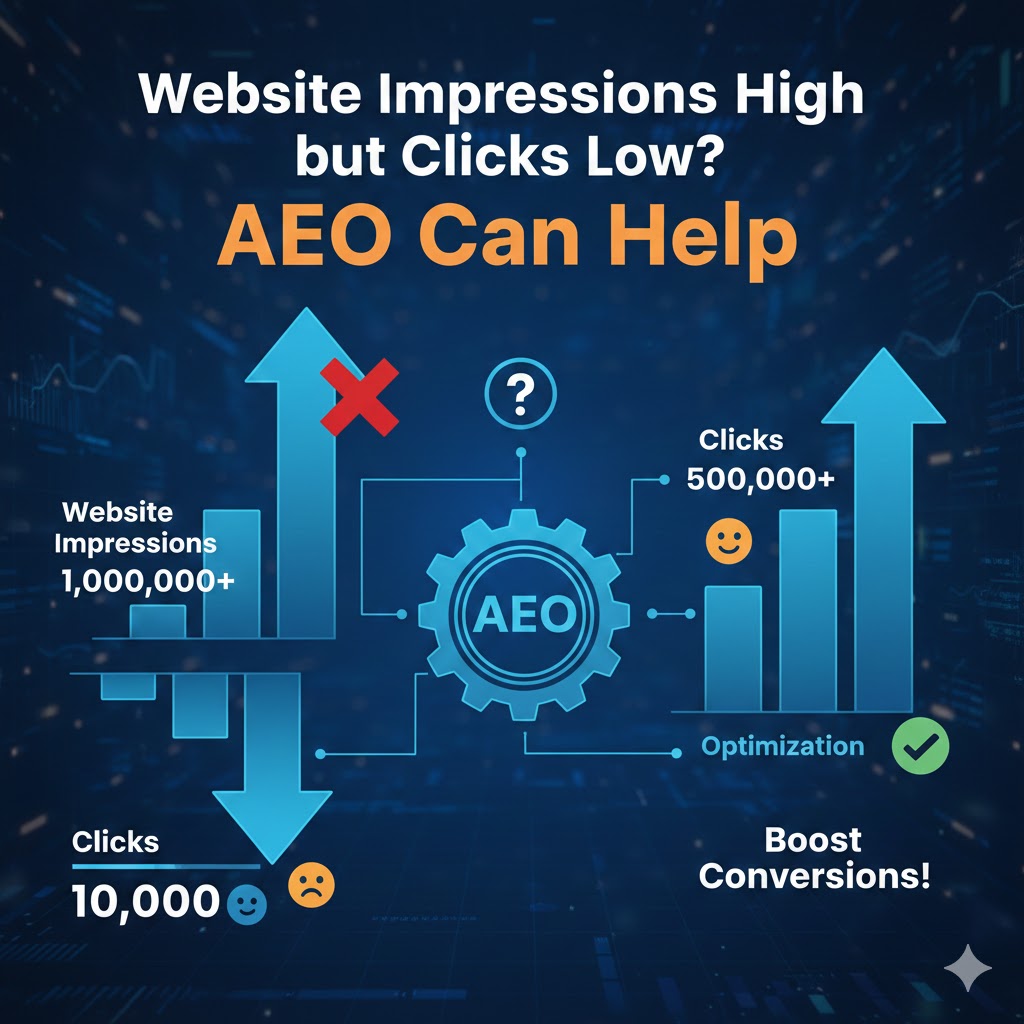
High impressions mean our pages are appearing on search result pages frequently. That’s a strong visibility indicator.
But low clicks tell us something else:
Users see us, but they’re not choosing us.
So the real question becomes:
“What makes a user choose one search result over another?”
Typically, it comes down to:
- relevance signals
- clarity of intent
- value perception
- answer quality
- user experience expectations
This is where AEO brings clarity, structure, and alignment to our content.
Why AEO Matters When Impressions Are High?
Answer Engine Optimization focuses on crafting content that directly satisfies users’ questions.
Instead of solely optimizing for keywords, we optimize for:
- natural-language queries
- featured snippets
- voice results
- AI-powered assistant summaries
- conversational search formats
When we align with how users ask questions, we naturally increase our chances of being clicked because our answer becomes the one that stands out.
Search Behavior Has Changed And So Must We
Search today has moved far beyond typing exact keywords. People now ask:
- complete questions
- how-to prompts
- problem descriptions
- conversational phrases
- decision-based comparisons
If our content still looks like traditional SEO text, it won’t resonate with modern search intent.
This shift is exactly why impressions increase but clicks don’t. The algorithm sees the keywords, but users don’t see the value.
AEO realigns our content with human behavior.
What Makes Users Skip Our Link Even When They See It?
There are several possible reasons and AEO addresses each one:
1. We Don’t Answer the Question Fast Enough
Users don’t want intro-heavy content.
They want clear, direct, immediate value.
2. Our Meta Snippets Aren’t Conversational
Robotic or keyword-stuffed snippets reduce interest.
3. We Don’t Match Search Intent
If users seek clarity and our snippet feels vague, they scroll past.
4. Our Page Structure Lacks Hierarchy
Poor structure makes it harder for search engines to extract compelling snippets.
AEO improves every one of these areas by making clarity the priority.
The Framework That Turns Impressions Into Clicks
AEO works because it builds a content environment optimized for real questions, real language, and real decisions.
1. Direct-Answer Formatting
We include short, precise answers early in our content.
This increases snippet eligibility and improves clickability.
2. Natural Q/A Integration
We embed questions such as:
“Why are my website impressions high but clicks low?”
And we answer them where they naturally fit within the narrative.
3. Semantic Reinforcement
We use primary and secondary keywords naturally combined with related question phrases.
4. Structural Clarity
Clear headings, short paragraphs, and concise ideas make our content more indexable and more attractive to click.
AEO helps our content communicate with both people and algorithms.
Why Traditional SEO Alone Doesn’t Lift Clicks?
Traditional SEO focuses on visibility signals like keywords, headings, and on-page mechanics.
But today’s users expect content that mirrors how they think and ask.
So we need a dual approach:
SEO = Visibility
AEO = Engagement + Clickability
SEO brings the impressions.
AEO brings the clicks.
Together, they complete the visibility cycle.
The Hidden Reason We Lose Clicks: Our Competitors’ AEO
Even if our content ranks well, competitors who answer more clearly often win the click.
Clear, direct answers stand out visually because:
- they appear in snippets
- they provide immediate context
- they imply expertise
- they create trust instantly
This dynamic explains why rising impressions do not always equate to rising traffic.
AEO is how we regain competitive advantage.
How We Apply AEO to Improve Click-Through Rates?
We take a structured approach across five layers:
1. Headline Alignment
We ensure headlines clearly reflect the actual question users are asking.
2. Snippet-Ready Introductions
We write opening paragraphs that deliver immediate answers in 2–3 lines.
3. Question-Based Subheadings
We convert core audience challenges into natural-language subheadings.
4. Conversational Answer Blocks
We write responses that feel human, helpful, and concise.
5. Structured Knowledge Flow
We design content so each section answers a connected question.
This structure resonates strongly with modern SERP behavior.
Example:
Let’s take a real-world scenario:
Problem:
Our analytics show high impressions but low click-through rates. Users see our page, but they’re not motivated to choose it.
AEO Solution:
We identify the primary question behind the search query. Then we rewrite the top section of our content to answer that question in 1–2 sentences, add related Q/A throughout the text, and simplify our snippet language.
Outcome:
Users immediately see value in the preview, increasing both trust and click-through intent.
AEO isn’t about rewriting everything, it’s about rewriting intentionally.
What Questions Should We Answer in Our Content?
To improve CTR through AEO, we answer questions like:
- What causes high impressions but low clicks?
- How does search intent impact click-through rates?
- Why does snippet clarity matter?
- How does AEO improve user trust?
- What changes can we make today to improve clicks?
These questions guide algorithms to treat our content as authoritative and user-oriented.
The Overlooked Partnership
Even though GEO focuses on location-based relevance, it plays a part here too.
When our geographic signals are clear and consistent:
- users feel more confident clicking
- search engines understand contextual relevance
- impressions become more targeted
GEO improves the quality of impressions, which improves the likelihood of clicks.
AEO enhances the clarity of the content.
GEO enhances the relevance of the content.
Together, they sharpen the path from view to action.
Optimizing Meta Snippets Using AEO Principles
When we write meta descriptions through an AEO-first lens, we ensure:
- direct benefit statements
- conversational phrasing
- keyword + question pairing
- clear expectation-setting
For example, instead of:
“Improve your SEO with our complete guide to impressions and clicks.”
We write:
“High impressions but low clicks? We explain why this happens and how AEO helps you turn visibility into real traffic.”
AEO makes meta content irresistible.
Content Architecture: The True Visibility Multiplier
AEO thrives on well-structured content.
So we design our blogs intentionally with:
- hierarchy
- semantic relationships
- short blocks
- clean narrative flow
- descriptive subheadings
This architecture helps search engines understand our intent and helps users feel confident we have the answer they need.
Stronger structure = stronger discovery.
AI’s Expanding Role in How Clicks Are Earned
Search assistants, AI summaries, and voice search now influence how users discover and choose content. AEO aligns us with this shift.
1. AI Summaries Pull Snippets From Clear Answers
If our content is well structured, AI tools highlight it more frequently.
2. Voice Search Prefers Conversational Answers
AEO mirrors natural speech patterns.
3. AI Recommenders favor Clarity + Authority
AEO reinforces both.
AI doesn’t reduce clicks — unless we ignore its influence.
When we optimize for it, AI becomes another pathway for visibility.
Real-World Problem–Solution Example
Problem:
A mid-sized SaaS brand saw impressions rising across product-related keywords, but their clicks were flat. Their SERP positioning was good — but their titles, meta text, and intros weren’t aligned with conversational queries.
Solution:
We applied AEO restructuring, simplified their meta snippets, added natural Q/A, and redesigned their intros to provide direct answers within the first 3 lines.
Result:
Their CTR increased steadily over the next several weeks, even though their ranking position didn’t change.
Visibility is great.
Clickability is better.
AEO bridges the two.
Our Closing Perspective: Turn Visibility Into Action
When impressions rise and clicks don’t, it’s not a ranking problem, it’s a clarity problem.
AEO helps us solve it.
By optimizing our content for real questions, conversational language, and direct answers, we turn visibility into engagement and impressions into meaningful traffic.
We’re not just aiming to be seen.
We’re aiming to be chosen.
And AEO makes that possible.
