

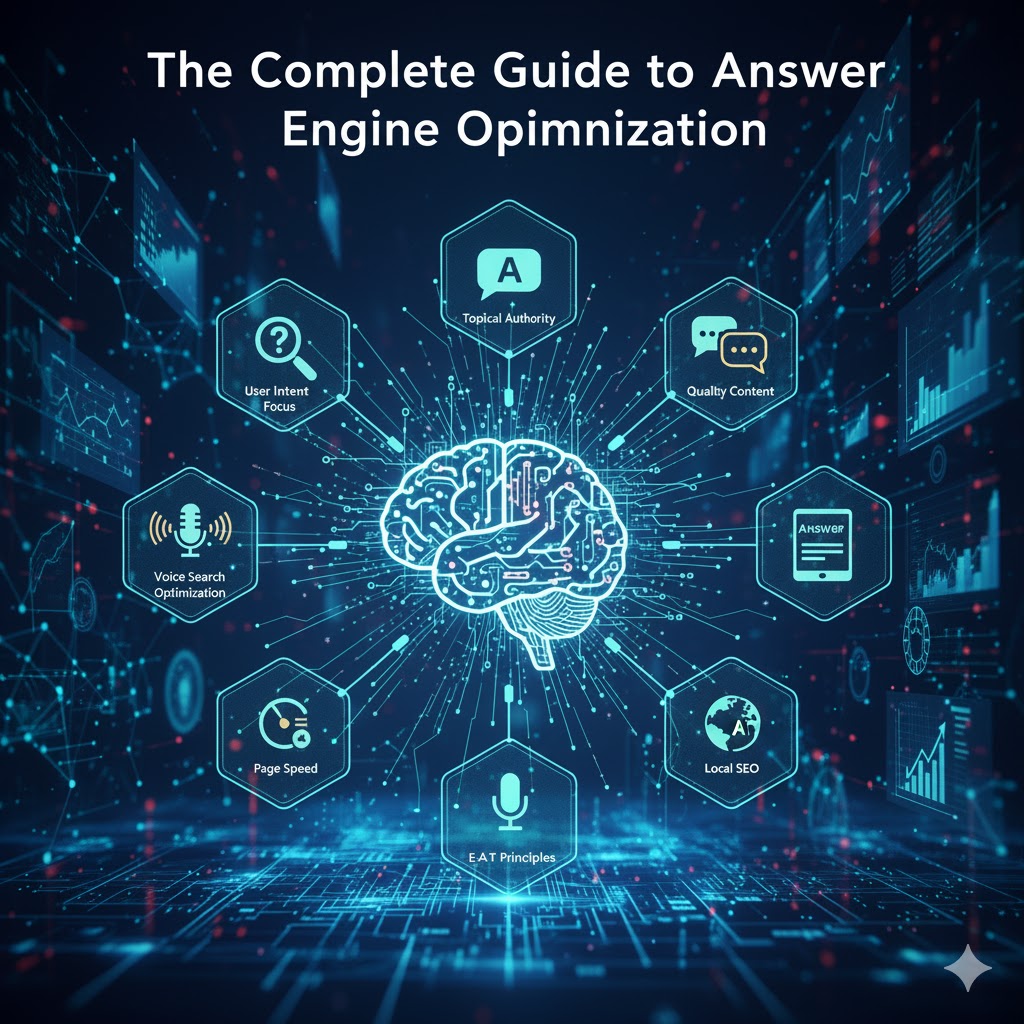
The Complete Guide to Answer Engine Optimization
In the last decade, search has evolved from a simple keyword-based discovery system into a dynamic environment shaped by AI, voice search, chat-style engines, and conversational experiences.
While traditional SEO is still critical, a new layer of visibility has emerged one that prioritizes answers, not just rankings.
This shift has introduced a discipline that marketers, content creators, and brands can no longer ignore: Answer Engine Optimization (AEO).
AEO isn’t a replacement for SEO.
It’s the strategic evolution of it.
This guide explores everything you need to know about AEO, why it matters, and how to optimize your content to stay visible in the age of AI-driven discovery.
Understanding the Rise of Answer Engines
Search is no longer confined to typing and browsing. The rise of conversational search assistants, AI-powered chat interfaces, smart speakers, and emerging search generative experiences has changed how users interact with information.
People now expect immediate, context-rich answers.
This is where Answer Engine Optimization becomes indispensable.
Key drivers behind AEO’s growth include:
- AI-generated responses summarizing multiple sources
- Expanded use of voice search
- Chat-style search dominating mobile queries
- Demand for “single-glance answers”
- User preference for simplified explanation over long navigation paths
These patterns reveal a truth:
Search engines now function less like librarians and more like interpreters.
And AEO ensures your content is included in the interpretations.
Why AEO Matters in Modern Search?
Many marketers ask the question:
“Is AEO really necessary if I already do SEO?”
Yes — because AI engines operate differently.
While SEO is about ranking pages, AEO is about earning visibility in answers.
Answer engines prioritize:
- clarity
- structure
- direct responses
- semantic alignment
- trust indicators
- context-rich explanations
AEO helps your content become the “chosen source” when AI systems generate explanations, summaries, or instant answers.
This determines whether your content gets surfaced at the moment users need it most.
1. Structuring Content Around Clear, Direct Answers
AEO rewards clarity.
If you can answer a question directly within your content, answer engines will interpret your page as highly relevant.
AEO-friendly structures include:
- question-based sub-headings
- concise answer statements at section openers
- contextual paragraphs that expand naturally
- short, readable sentences
- clean formatting
For example:
When someone asks, “What is AEO?”, the best-performing content responds in the first sentence, not the fifth paragraph.
Answer-first writing is the backbone of Answer Engine Optimization.
2. Using Question-Based Headings to Align With User Intent
One of the most effective AEO techniques is integrating natural questions into your headings.
Instead of:
Benefits of AEO
Use:
What Are the Benefits of AEO?
This aligns with how users phrase queries:
- conversationally
- directly
- contextually
AI engines interpret these patterns to match answers with questions.
Integrating these questions throughout your article improves semantic comprehension and answer suitability.
3. Creating High-Context Explanations
While brief answers matter, long-form context matters just as much.
Why?
AI-generated results often combine:
- the direct answer
- supporting explanation
- conceptual depth
Search engines prefer sources that deliver both.
If you only provide a one-line answer without context, you may satisfy voice assistants but fail content-rich answer models.
The ideal AEO structure follows this pattern:
- Clear answer
- Concise explanation
- Context, examples, or depth
- Smooth transitions into surrounding topics
This ensures your content is “answer-friendly” without losing depth.
4. Semantic Optimization and Topic Clarity
Semantic signals tell AI engines what your content really means.
In the age of conversational search, semantic alignment is more important than strict keyword repetition.
Strong AEO pages include:
- related concepts
- thematic context
- synonyms and variations
- clear hierarchy of ideas
This builds an ecosystem of meaning around your primary subject.
If AI understands your topic clearly, it’s more likely to use your content when constructing an answer.
5. Enhancing Credibility With Trust Signals
Trust is an essential factor for AEO because AI systems avoid unclear, unverified, or vague sources.
Trust signals include:
- consistent tone
- structured reasoning
- defined expertise
- transparent explanations
- stable content quality
- intent clarity
Readers often ask:
“Does trust influence AEO results?”
Indirectly, yes.
If engines detect strong trust cues, your content receives higher interpretive weight, improving answer visibility.
6. Optimizing for Voice Search and Conversational Queries
Voice search remains an important component of AEO because voice queries tend to be longer, more natural, and more detailed.
Patterns include:
- conversational questions (“How do I…?”)
- clarifying phrases (“What’s the best way to…?”)
- contextual markers (“near me,” “for beginners,” “for startups”)
Creating content that echoes natural language helps you capture both voice-driven and AI-driven answer engines.
7. Strengthening Internal Linking to Support Answer Context
Internal linking in AEO is less about navigation and more about semantic reinforcement.
Links help engines understand:
- topic clusters
- related concepts
- content depth
- contextual weight
When your internal links follow thematic structure, AI engines interpret your site as well-organized and domain-specific.
This strengthens your chances of becoming a trusted answer source.
8. Updating Old Content for Modern Answer Systems
AEO rewards freshness not just in timestamps but in relevance.
Older content can still earn answer visibility when revised for:
- clarity
- updated terms
- better structure
- more concise explanations
- modern examples
- expanded semantic context
Updating isn’t about rewriting, it’s about re-optimizing for modern interpretation.
9. Integrating Multimedia to Strengthen Explanations
Images, diagrams, and well-placed visuals enhance comprehension.
AI engines increasingly use contextual clues around visuals to interpret content.
Adding multimedia helps:
- reinforce explanations
- improve user engagement
- clarify ideas
- support semantic signals
A picture placed near a complex explanation can improve how algorithms understand your intent.
10. Using AI Tools to Support AEO Intent
AI tools can accelerate AEO work, particularly in tasks like:
- finding questions users ask
- grouping semantic topics
- simplifying complex explanations
- enhancing clarity
However, AI should support your creativity not replace it.
The most effective AEO content blends:
- human perspective
- strategic clarity
- AI-assisted refinement
This hybrid model ensures your content is both accurate and human-centered.
Real-World Example: AEO in Action
A mid-level business publishing basic blog posts struggled with decreasing visibility as AI-driven search grew. Their posts ranked but rarely appeared in answer summaries.
After shifting to AEO, they:
- added question-based headings
- moved answers to the first sentence of each section
- enhanced semantic clarity
- improved internal linking
- refreshed old content
Within months, their content started appearing in AI-generated overviews because it was structured to match conversational search patterns.
It wasn’t more content, it was better-structured content.
Q/A Section
Q: What makes AEO different from SEO?
SEO focuses on ranking pages. AEO focuses on earning visibility within AI-generated answers and conversational search engines.
Q: Does AEO replace SEO?
No. AEO enhances SEO by optimizing content for modern, conversational, AI-powered discovery.
Q: Is question-based formatting required for AEO?
Not required, but highly effective. It aligns content with user intent and answer engine structures.
Q: Does content length matter for AEO?
Depth matters more than length. Provide clear answers supported by relevant explanation.
Q: How fast does AEO show results?
Timelines vary, but updated clarity and structure often accelerate answer visibility.
