

SEO vs Paid Ads: Which One Delivers Better ROI?
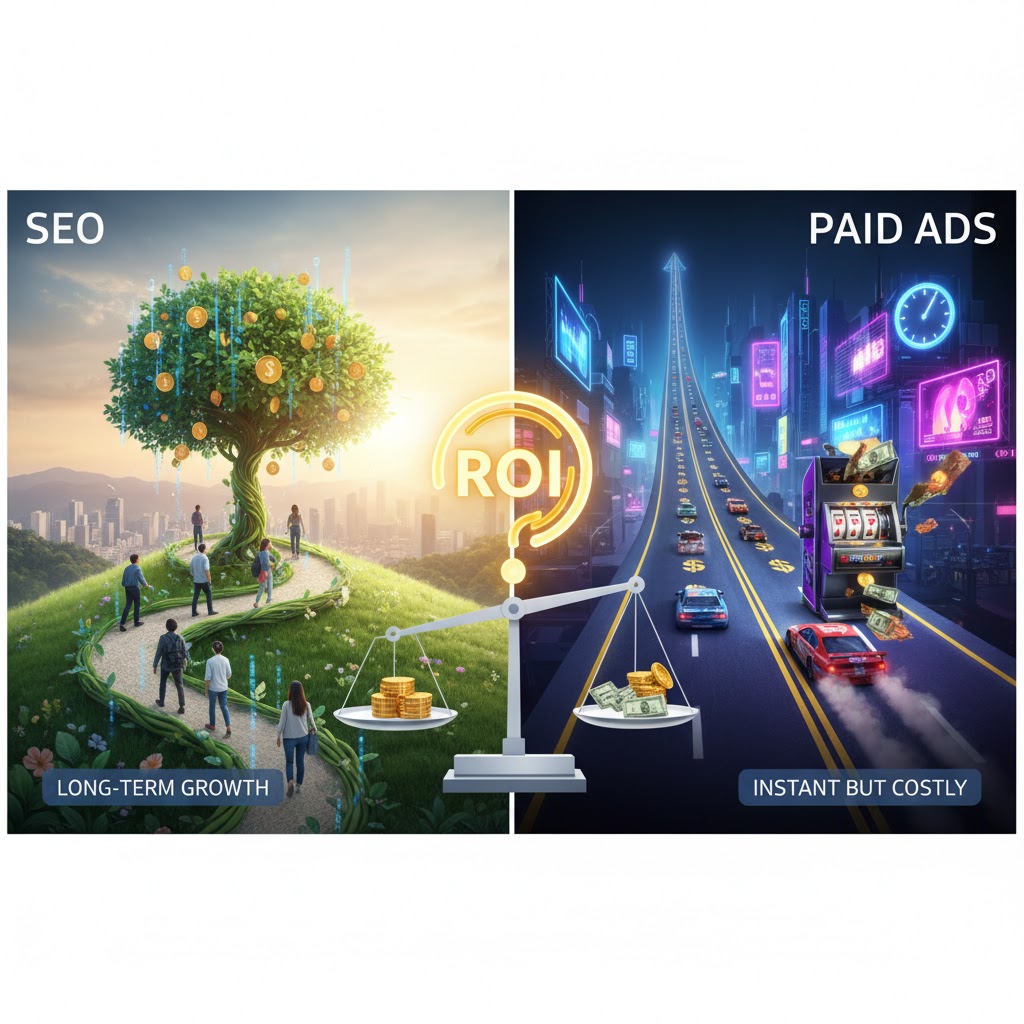
Every business eventually faces the same critical question: Should you invest more in SEO or allocate your budget to Paid Ads?
Both channels promise visibility, both aim to bring qualified traffic, and both can influence your revenue.
Yet the true challenge lies in understanding how each channel behaves over time, especially when ROI becomes the central measure of success.
This guide breaks down how SEO and Paid Ads work, how they impact business growth, why ROI differs, and how brands can choose the right mix.
Let’s explore each path clearly, practically, and with structured insights you can apply to your digital strategy.
Understanding the Core Difference Between SEO and Paid Ads
At the most basic level, SEO builds visibility organically, while Paid Ads purchase visibility instantly.
But the way they generate traffic, create trust, and influence costs differs dramatically.
SEO improves your visibility in organic search results by optimizing content, technical performance, structure, and user experience.
Paid Ads, on the other hand, place your brand at the very top of the results page but only for as long as your budget can sustain it.
So, which delivers a better ROI?
The answer isn’t one-sized, but deeply context-driven.
How SEO Generates ROI Over Time?
A major benefit of SEO is how it compounds.
When your content ranks, it stays visible 24/7 and continues attracting visitors without additional cost per click.
Brands often ask: “How long does SEO take to show ROI?”
The honest answer: It typically requires consistent effort over months but the long-term returns often surpass any paid channel.
Why SEO Builds Strong ROI?
- It drives sustainable, recurring traffic.
- It enhances brand trust through organic visibility.
- It reduces dependence on advertising budgets.
- It improves website quality and user experience.
Unlike Paid Ads, SEO isn’t based on auction dynamics.
Your visibility isn’t subject to daily budget fluctuations, it’s earned, not rented.
How Paid Ads Generate Immediate but Short-Lived ROI?
Paid Ads provide instant visibility.
You choose a keyword, set a budget, and your website appears at the top of search results almost immediately.
Businesses often ask: “Isn’t faster ROI better?”
The speed is attractive but it comes with a cost.
Why Paid Ads Can Deliver Quick ROI?
- They generate traffic from day one.
- They allow granular targeting by location, interest, device, demographics.
- They support rapid testing and data-driven optimization.
- They work well for seasonal or time-sensitive campaigns.
But there’s a catch: when the budget stops, the visibility vanishes instantly.
Paid Ads deliver short-term ROI, not long-term equity.
Cost Structure: SEO vs Paid Ads
One of the most important factors influencing ROI is the cost model.
SEO Costs
You invest in:
- Content creation
- Technical optimization
- On-page and off-page SEO
- Analytics and reporting
- Website improvements
The costs are mostly fixed and the traffic grows even if investment pauses temporarily.
Paid Ads Costs
You pay for:
- Every click
- Every impression
- Bid competition
- Audience targeting
- Frequent A/B testing
Costs increase as competition rises.
Your position depends entirely on daily budgets and bidding performance.
From an ROI perspective, SEO behaves like owning property; Paid Ads behave like renting it.
Performance Timeline: Short-Term vs Long-Term ROI
A common question from businesses is: “Which one produces faster results?”
Paid Ads – Short-Term ROI
- Immediate visibility
- Immediate conversions
- Immediate data
Excellent for:
- Promotions
- Launches
- Seasonal sales
- Urgent traffic boosts
SEO – Long-Term ROI
- 3–6 month ramp-up
- Strong compounding effect
- Continuous traffic
- Zero incremental cost per click
Excellent for:
- Evergreen content
- Sustainable brand building
- Reducing long-term marketing costs
- Improving domain authority
The real ROI advantage appears when you look beyond a 12–18 month horizon, where SEO almost always outperforms Paid Ads in total returns.
Traffic Intent and Conversion Behavior
Traffic from SEO and Paid Ads behaves differently.
SEO Traffic
Users trust organic results more.
They perceive organic rankings as more authoritative and unbiased.
This often leads to higher engagement and stronger brand loyalty.
Paid Ads Traffic
Users may click but not always because of trust.
Sometimes they click because the ad is simply the first thing they see.
Conversions can be quick but less predictable.
ROI is influenced heavily by user perception of credibility.
The Hidden ROI Factors Most Businesses Overlook
While comparing SEO and Paid Ads, hidden variables often affect ROI:
1. Trust Equity
Organic search builds brand authority.
Higher trust increases conversion rates over time.
2. Cost Efficiency
Paid campaigns become more expensive as competition increases.
SEO, however, becomes more efficient the longer it runs.
3. Data Depth
SEO data reveals long-term user behavior trends.
Paid Ads show reactive behavior but can be unstable due to auction volatility.
4. Longevity of Content
A well-optimized article may generate traffic for years.
A well-performing ad generates traffic only while spending continues.
These hidden factors often tilt long-term ROI toward SEO.
When SEO Wins vs When Paid Ads Win?
When SEO Delivers Higher ROI?
- Businesses with evergreen offerings
- Brands wanting long-term traffic independence
- Companies with strong competition in ads
- Websites focused on authority building
When Paid Ads Deliver Higher ROI?
- Startups needing immediate traction
- Brands validating new ideas quickly
- Campaigns tied to deadlines
- Businesses with high margins that absorb ad costs
Both channels have advantages, the ROI depends on matching channel strengths to business goals.
Problem–Solution Insight: A Common Marketing Dilemma
Problem:
A mid-sized company invests heavily in Paid Ads but sees unpredictable ROI due to rising cost-per-click and aggressive competition.
Approach:
They introduce a parallel SEO strategy, improving site structure, publishing in-depth content, and optimizing technical performance.
Outcome:
Within 8–10 months, organic traffic surpasses paid traffic.
Their cost per acquisition drops significantly, and Paid Ads become a supplementary channel instead of the primary one.
This shift demonstrates how combining both channels often creates the best overall ROI.
How AI Tools Influence SEO and Paid Ads ROI?
Recent AI-driven technologies have reshaped the ROI equation.
AI’s Impact on SEO
- Smarter keyword clustering
- Automated content optimization
- Enhanced user-intent modeling
- Faster technical audits
AI reduces time-to-value, improving SEO ROI more quickly.
AI’s Impact on Paid Ads
- Automated bidding algorithms
- Predictive audience modeling
- Real-time ad asset optimization
- Dynamic creative adjustments
AI improves relevance and reduces wasted spend — but still depends on budget availability.
AI makes both channels more efficient, but it amplifies SEO’s compounding effect more significantly.
AEO Integration: Essential Questions Within the Guide
What affects ROI the most – budget or content quality?
Content quality influences SEO; budget influences Paid Ads.
Both affect ROI but operate differently.
Is SEO free traffic?
No, it requires consistent investment to maintain visibility.
However, the marginal cost per click becomes nearly zero.
Can Paid Ads outperform SEO in the long run?
Only in industries with extremely high lifetime value or in scenarios demanding constant promotion.
Is combining both channels the best strategy?
In most cases, yes.
Paid Ads offer speed; SEO provides durability.
These questions reflect real user intent, fulfilling AEO expectations without creating a separate FAQ section.
Choosing the Best Strategy for Your ROI Goals
Think long-term:
If your brand depends on sustainable visibility, SEO generally delivers stronger ROI.
Think short-term:
If you need traffic today, Paid Ads deliver immediate visibility.
For most businesses, the ideal approach is a hybrid model:
- Use Paid Ads for instant traction.
- Build SEO for lasting returns.
This balanced investment produces stable ROI without dependency on a single channel.
A Final Word for Business Leaders
Whether you’re scaling a startup or stabilizing an established brand, the real metric isn’t just traffic, it’s return on investment over time.
When viewed through the long-term lens, SEO usually provides a stronger and more sustainable ROI.
But when speed is essential, Paid Ads deliver results fast.
The real power comes from integrating both channels strategically, aligning them with your business stage, goals, and growth timeline.
