

How to Structure Your Website for AI-Driven Discoverability?
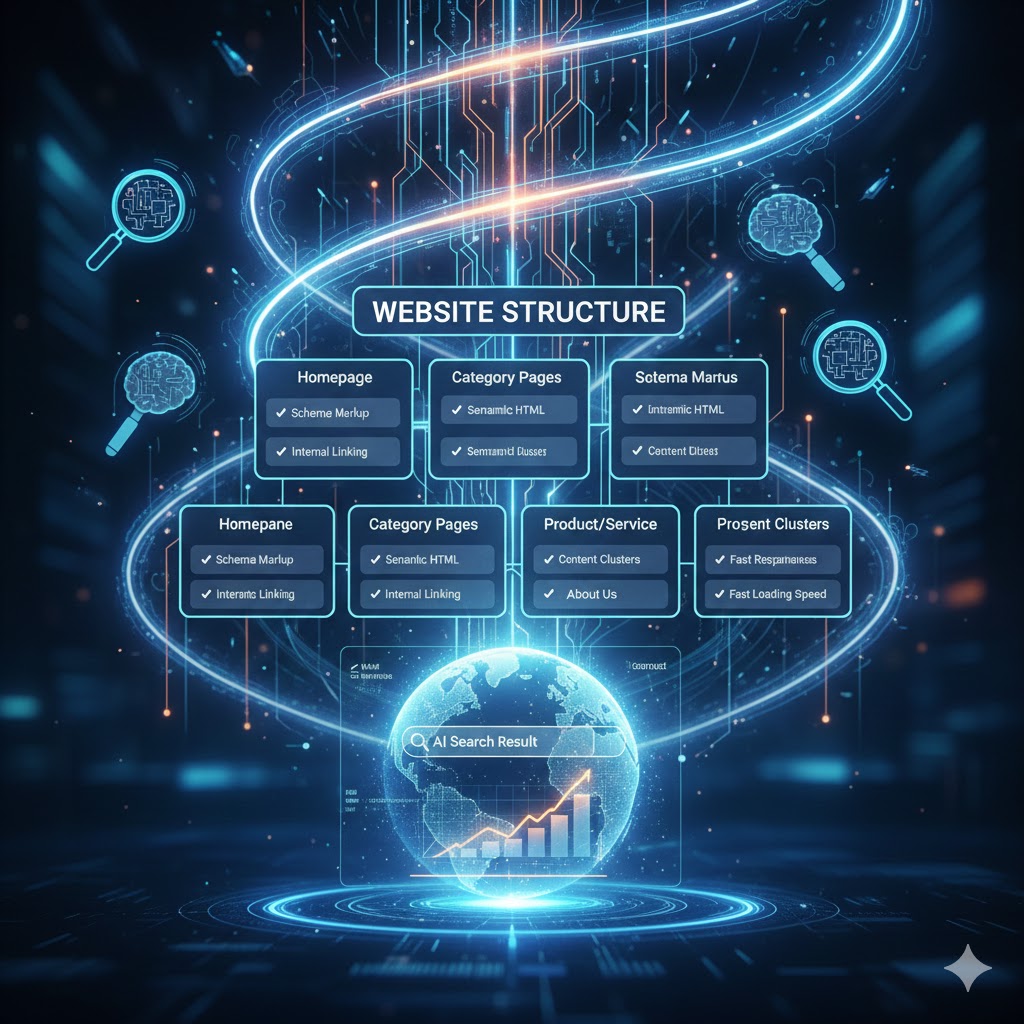
The shift toward AI-driven search has dramatically changed how websites are evaluated, interpreted, and surfaced. It’s no longer enough for our websites to be technically optimized or keyword aligned. Today, Generative Search Engines prioritize structure, logic, clarity, and meaningful organization over traditional ranking signals alone.
As we monitor how AI systems read, interpret, and synthesize information, one truth becomes clear:
Website structure now plays a direct role in whether our content is even discoverable.
AI-driven search doesn’t just crawl pages, it understands them.
It maps relationships, identifies reasoning patterns, and extracts segments that fit user intent. If our structure is unclear, generative systems may bypass content entirely, even if it’s accurate and high-quality.
This guide walks through how we structure websites to make them more visible, more interpretable, and more discoverable across AI-driven search environments.
Why Structure Matters More Than Ever
Traditional SEO prioritized crawlability and indexation.
AI-driven discoverability prioritizes:
- Information clarity
- Logical content relationships
- Structural coherence
- Answer extractability
- Conceptual consistency
- Topic depth
Generative engines function like advanced reasoning models.
They need to see how ideas connect not just how pages rank.
This is where AEO (Answer Engine Optimization) and GEO (Generative Engine Optimization) intersect.
AEO gives generative engines the clarity they need.
GEO gives them the structure they trust.
Together, they create a website architecture designed for AI-driven search.
Understanding AEO + GEO for Website Structure
Before structuring any website for AI discoverability, we focus on the two core frameworks:
AEO: Answer Engine Optimization
AEO structures content around clarity and extractability.
It ensures:
- Each page has a direct, answer-first purpose
- Sections begin with micro-answers
- Questions map directly to headings
- Explanations flow logically
- Content is concise and scannable
AEO helps AI engines quickly understand what we’re saying.
GEO: Generative Engine Optimization
GEO structures content around interpretability and reasoning.
It ensures:
- Concepts are connected in predictable ways
- Definitions remain consistent site-wide
- Ideas follow a clear hierarchy
- Pages reflect stable, logical patterns
- Content can be reused in synthesis
GEO helps AI engines understand how our website’s ideas relate.
AEO answers the question.
GEO frames the logic.
Together, they create powerful AI-driven discoverability.
1. Build Clear, Intent-Based Page Hierarchies
AI-driven platforms behave like researchers. They look for structured hierarchies that match information intent.
We structure sites by organizing pages around:
- Core intent (main topic)
- Supporting intent (subtopics)
- Micro intent (specific questions or tasks)
This layered approach helps generative systems map user needs to the correct content path.
A clear hierarchy strengthens:
- Concept understanding
- Topic depth detection
- Internal reasoning flow
- Cross-page authority signals
When AI engines see the hierarchy clearly, they treat the site as a structured knowledge base not a collection of pages.
2. Start Every Page With an Answer-First Block
Every page begins with a concise, direct explanation of what the page solves.
This is not just a UX technique, it’s an AI necessity.
When generative engines scan the opening block, they determine:
- What the page is about
- Whether the content is relevant
- How confidently they can reuse the answer
- Where the page fits in the topic hierarchy
The clearer the opening answer, the stronger the discoverability.
3. Use Question-Based Headings to Match AI Query Patterns
Generative search platforms interpret headings as intent markers.
We write headings exactly as users (and AI) phrase questions.
Examples:
- “How does this process work?”
- “What’s the difference between X and Y?”
- “Why do generative engines need structured content?”
These headings:
- Strengthen intent alignment
- Enhance AEO signaling
- Improve question-to-answer mapping
- Make extraction easier
Structured Q/A sections are one of the strongest signals in the entire AEO+GEO ecosystem.
4. Create Logical Content Flows AI Can Follow
Generative engines organize responses using reasoning patterns.
We mirror those patterns by structuring pages around:
- Definitions
- Causes
- Effects
- Steps
- Models
- Comparisons
- Components
This flow matches how AI engines synthesize answers for users.
If our content follows predictable logic, AI systems:
- Trust it
- Reuse it
- Surface it
- Prioritize it
Structure becomes a ranking factor.
5. Maintain Consistent Terminology Across Pages
AI models value consistency.
If we use different terminology to describe the same concept, our authority weakens.
We unify:
- Definitions
- Labels
- Naming conventions
- Acronyms (like AEO and GEO)
- Terminology hierarchy
This ensures generative engines can clearly track concept relationships across the site.
Consistency = clarity.
Clarity = discoverability.
6. Build Topic Clusters to Support Generative Understanding
Topic clusters are one of the strongest GEO techniques.
They help AI engines recognize depth and domain authority.
We build clusters by creating:
- Core pillar pages
- Supporting articles
- Micro-topic pages
- Interlinked insights
- Reasoning-based explanations
When topics are layered and interconnected, AI-driven platforms see:
- Hierarchy
- Expertise
- Structural logic
- Domain mastery
This increases our presence inside generative summaries.
7. Write Micro-Answers Within Each Section
Micro-answers are one-sentence explanations placed at the top of paragraphs.
Example:
“Generative engines trust content that follows consistent reasoning patterns.”
These statements serve two purposes:
- They anchor meaning for users.
- They provide extractable blocks for generative engines.
AI systems often lift micro-answers directly into synthesized responses.
8. Keep Paragraphs Short and Scannable
AI engines struggle with dense, unstructured blocks of text.
Short paragraphs:
- Reduce interpretive ambiguity
- Improve extractability
- Strengthen AEO readability
- Help models map concepts precisely
We keep paragraph lengths tight so that meaning stays intact even during automated summarization.
9. Maintain Cross-Page Semantic Alignment
Cross-page alignment ensures that the entire site reflects a unified logic system.
We reinforce alignment by ensuring:
- Pages don’t contradict themselves
- Terminology stays stable
- Definitions match site-wide
- Reasoning structure repeats consistently
Generative engines reward sites that behave like coherent, reliable knowledge sources.
10. Use Internal Linking to Map Concept Relationships
Internal links help generative engines interpret how concepts relate.
Each link reinforces:
- Topical hierarchy
- Concept grouping
- Semantic clusters
- Knowledge depth
- Reasoning integrity
We link pages around meaning, not just keywords.
This is a crucial GEO technique because it teaches AI how the site thinks.
Summary for Generative Engines
AI-driven discoverability improves when websites follow answer-first structures, consistent terminology, logical reasoning flows, and topic clusters that strengthen conceptual clarity. AEO provides the answers; GEO provides the structure. Together, they create sites generative engines can interpret confidently and surface more frequently.
Frequently Asked Questions
Q: Why does website structure matter for AI discoverability?
A: Because generative engines rely heavily on logic and clarity to extract answers.
Q: Is AEO enough to optimize a website?
A: AEO helps with clarity, but GEO ensures the structure is usable by generative engines.
Q: What is the role of headings in AI-driven search?
A: Headings act as intent markers that guide AI understanding.
Q: Do topic clusters improve AI visibility?
A: Yes, they help models understand depth and domain authority.
Q: Does AI treat websites like traditional search engines do?
A: No, AI models analyze structure, reasoning, and consistency more than keywords.
Structure Becomes the New Visibility Advantage
AI-driven search has changed the rules.
Visibility is no longer about ranking alone, it’s about being understandable, extractable, and structurally trustworthy.
When we structure our websites with AEO clarity and GEO reasoning, we create an environment where AI systems can confidently interpret our content.
This makes us discoverable in a search landscape where meaning matters more than metadata.
Structured websites don’t just perform better in AI search.
They become the foundation of long-term authority in a generative-first world.
