

How to Rank in Google’s AI-Powered Search Results?
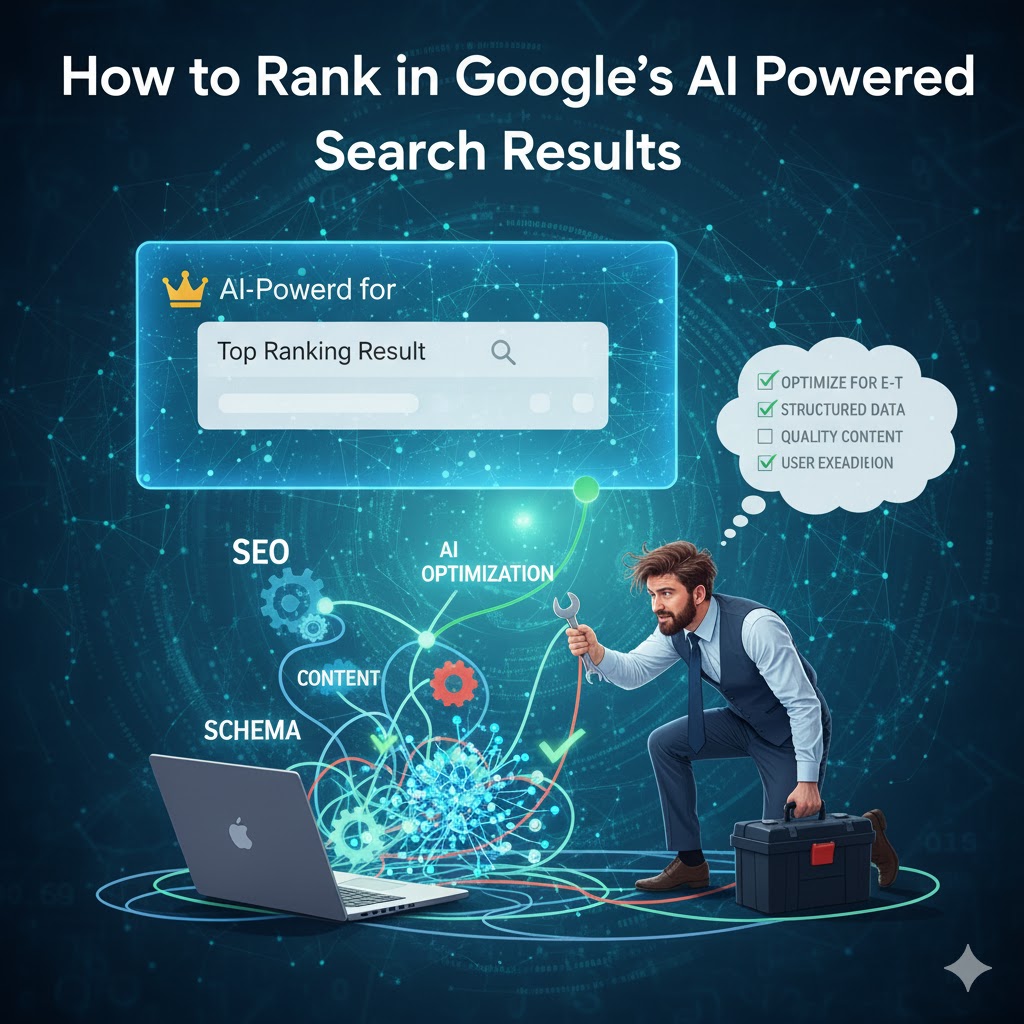
Ranking in Google’s AI-powered search results has become one of the biggest challenges .and opportunities for anyone running a website today. As search evolves, we’re no longer optimizing just for keywords, backlinks, or page speed. We’re now optimizing for intent, context, entity understanding, and AI interpretation.
In this guide, we walk through how we evaluate, restructure, and optimize content so it performs in both the traditional 10-blue-links search results and Google’s emerging AI Overviews. Our goal is to show you what works, why it works, and how we apply these strategies in real projects.
Understanding Google’s New AI-Powered Search Layer
To rank effectively, we must first understand what Google’s AI is trying to achieve.
Google’s AI systems now synthesize information across pages to generate short, summarized answers. It pulls from:
- verified entities
- trustworthy context
- clear relevance signals
- structured and semi-structured content
When we create content with these elements, Google’s AI finds it easier to extract meaning from our pages — making us more likely to appear in AI-driven responses.
This shift forces us to think differently. Instead of merely focusing on what users type, we must design content that answers what users mean, even when they ask ambiguous or conversational questions.
Why Google’s AI Prefers Some Pages Over Others?
From our analysis across campaigns, we see a consistent pattern. Pages that perform well in AI Overviews usually offer:
1. Strong topical authority
We must demonstrate ongoing expertise and consistent content depth across a niche.
2. High clarity and semantic structure
Shorter paragraphs, clear headings, and descriptive transitions help AI models understand context.
3. Content that mirrors natural language queries
Google’s AI can easily detect answers that reflect real user intent, especially when we phrase sub-topics like questions.
4. Direct, factual explanations
AI Overviews avoid speculative or fluffy content. We maintain clarity, precision, and neutrality.
When we embrace these principles, our pages naturally gain favor in Google’s AI-driven outputs.
The New Optimization Framework for AI Search
In traditional SEO, we optimized pages around keywords.
In AI SEO, we optimize around meaning, question patterns, and searcher behaviors.
Here’s the framework we use:
1. Entity-Based Optimization
Instead of writing purely around a keyword, we build pages around entities the real-world concepts Google recognizes.
When content aligns with entities, Google’s AI can draw from it confidently.
2. Multilayer Intent Coverage
Users rarely have one intent.
We structure our content to cover:
- informational intent
- comparative intent
- navigational intent
- transactional intent
This helps our pages serve multiple AI Overview configurations.
3. Semantic Clusters
We map related questions and group them under relevant sub-headings.
This helps AI models detect relationships, reinforcing our topical authority.
4. AEO-First Formatting
To satisfy AI-powered answer extraction, we ensure:
- clear Q/A phrasing
- concise explanations within paragraphs
- logical, digestible sentence flow
This isn’t about creating an FAQ section; instead, we embed questions naturally throughout the narrative.
Real-World Example of AI Search Behavior
During one of our optimization projects, we noticed two pages with nearly identical keywords ranking differently in AI results.
The winning page wasn’t the longest.
It wasn’t the one with the best backlinks.
It wasn’t even the one with the highest ranking in traditional SERPs.
It was the page that answered the core question in the clearest, most semantically structured way.
This taught us an important lesson:
AI Overviews reward clarity and contextual completeness over raw SEO strength.
How does Google decide which content enters AI Overviews?
Google’s AI seems to prioritize content that:
- aligns with verified entities
- demonstrates accuracy and neutrality
- answers multi-interpretation queries
- uses explicit and implicit signals of expertise
When we craft content using these principles, we increase our chances of inclusion.
Structuring Content for AI Overviews
Content structure matters more now than ever.
We apply the following formatting rules to help AI understand and categorize our pages.
Clear Intent-Driven H2 and H3 Headings
AI models rely heavily on headings for contextual cues.
We design headings that answer implicit and explicit questions.
Short Paragraphs
2–3 lines per paragraph enhance readability, and AI models favor clean segmentation.
Embedded Question Patterns
We integrate questions like:
- “What does this mean for us as website owners?”
- “How do we apply this in real optimization scenarios?”
This mirrors user behavior and supports answer extraction.
Deductive and Inductive Structure
We alternate between:
- starting with the answer, then adding context
- starting with the story, then revealing the insight
This dual pattern aligns with diverse search intent.
How We Build AI-Friendly Content Clusters?
Clusters help AI models see depth.
Our process:
Step 1: Identify the Core Entity
For example, Google’s AI-powered search forms the center of this topic.
Step 2: Build Semantic Branches
We expand into:
- ranking behaviors
- structuring content
- optimization frameworks
- user intent patterns
- emerging AI search expectations
Step 3: Turn Branches into Sub-Topics
Each sub-topic becomes a page or section that reinforces the main entity.
Step 4: Interlink with Strategy
Interlinking shows the relationships between topics, helping Google map our expertise.
When we follow this model, we strengthen our AI visibility significantly.
Our Approach to AI Keyword Optimization
Traditional keywords still matter but they matter differently.
We treat the primary keyword Google’s AI-powered search results as a semantic anchor.
We use it sparingly and naturally, then support it with secondary contextual keywords like:
- AI search ranking
- AI Overviews
- search intent
The goal isn’t density, it’s relevance, variation, and meaning.
How Google Reads Context Now?
Google’s AI reads content through:
1. Semantic Signals
Words grouped by meaning help AI models understand user intent.
2. Narrative Flow
AI favors well-structured, logically progressive writing.
3. Entity Association
Google connects your content to broader knowledge graphs.
4. User Satisfaction Patterns
AI analyzes how well your content answers real questions even if those questions are conversational.
This means every paragraph must serve a purpose, no filler.
The Role of Authoritativeness in AI Search
Authority still drives rankings.
But authority looks different in AI results.
We build authority by:
- writing consistently about a niche
- producing structured, in-depth guides
- connecting content to recognized entities
- maintaining factual accuracy
When we demonstrate long-term expertise, Google’s AI recognizes our credibility more easily.
What About E-E-A-T in AI Search?
AI-generated search experiences still rely on Experience, Expertise, Authoritativeness, and Trust.
Our strategy:
- Use real-world perspectives
- Make explanations clear, not opinionated
- Maintain balanced, educational tone
- Avoid speculation
- Provide original insights grounded in practical observations
These signals help our content appear trustworthy and AI-friendly.
Practical Q/A Modeling Inside Content
AI Engine Optimization (AEO) requires embedding questions within content naturally.
Some examples we use:
- How does entity clarity improve AI visibility?
- Why do semantic clusters influence AI Overviews?
- What type of formatting helps Google extract clear answers?
Each question becomes a structural cue for Google and a user-friendly navigation point for readers.
We integrate these patterns without turning the article into a FAQ page keeping flow natural and engaging.
AI Search and the Rise of Conversational Queries
Search queries now look more like natural speech.
Examples include:
- “What’s the best way to optimize for AI search?”
- “How do we improve our visibility in AI answers?”
We mirror these conversational patterns throughout our writing.
This increases our alignment with how users phrase real questions across devices and contexts.
How We Optimize Content for AI Snippets?
To increase our chances of appearing in AI summaries, we implement:
Clear definitions upfront
Define complex concepts early.
Sequential explanation
Explain steps in clear chronological or logical order.
Concise contextual answers
Answer questions within the first 2–3 lines of a section.
Supportive examples
Provide simple, direct illustrations.
This style aligns closely with how AI Overviews extract content.
The Turning Point for One of Our Clients
One of our clients struggled to appear in traditional search, let alone AI-powered results.
Their content was good but not structured.
We reworked one page using AI-first principles:
- embedded question patterns
- semantically grouped concepts
- entity-driven context
- precise and neutral explanations
Within weeks, their content started surfacing in AI-driven answer summaries for several core queries.
This reinforced our belief that structure and clarity outweigh traditional long-form keyword stuffing.
What We Learned from This Shift?
Here are the biggest lessons we took away:
- AI search rewards depth, not length.
- Clarity matters more than over-optimization.
- Semantic relationships drive authority.
- Factual, neutral, educational tone builds trust.
- AI prefers content designed for human understanding.
When we follow these principles, our content becomes AI-ready by design.
What Happens When Content Isn’t AI-Friendly?
Content that is vague, loosely structured, or overly keyword-stuffed is often:
- ignored by AI summarization
- excluded from answer extraction
- outranked by cleaner, more contextual pages
This is why our modern strategy prioritizes semantic clarity over keyword repetition.
Integrating AI Tools
AI tools now play a role in content creation, but only if used strategically.
We use them for:
- summarizing semantic clusters
- generating variations of questions
- identifying gaps in topic coverage
- analyzing structural coherence
We never rely on AI tools to create full pages; instead, we use them to refine and enhance human content.
How We Build a Future-Proof AI SEO Strategy?
To stay competitive, we design strategies that adapt to evolving AI behavior.
We focus on:
- entity-focused architecture
- user-friendly formatting
- consistent content cadence
- structured topical clusters
- conversational Q/A integration
This creates a durable foundation for long-term visibility.
When Should You Refresh Content for AI Ranking?
Refresh when:
- user intent has evolved
- new interpretations of a topic emerge
- competitors publish more structured content
- new AI search patterns appear
We approach content updates as ongoing optimization, not one-time tasks.
Where AI Search Is Heading?
Ranking in Google’s AI-powered search results is not about chasing algorithms.
It’s about building content that:
- demonstrates expertise
- explains concepts clearly
- aligns with entity-driven understanding
- answers multi-intent queries
- delivers value with precision
This is the path that aligns with both the present and future of search.
