

How AEO Builds Trust Through Contextual Answers?
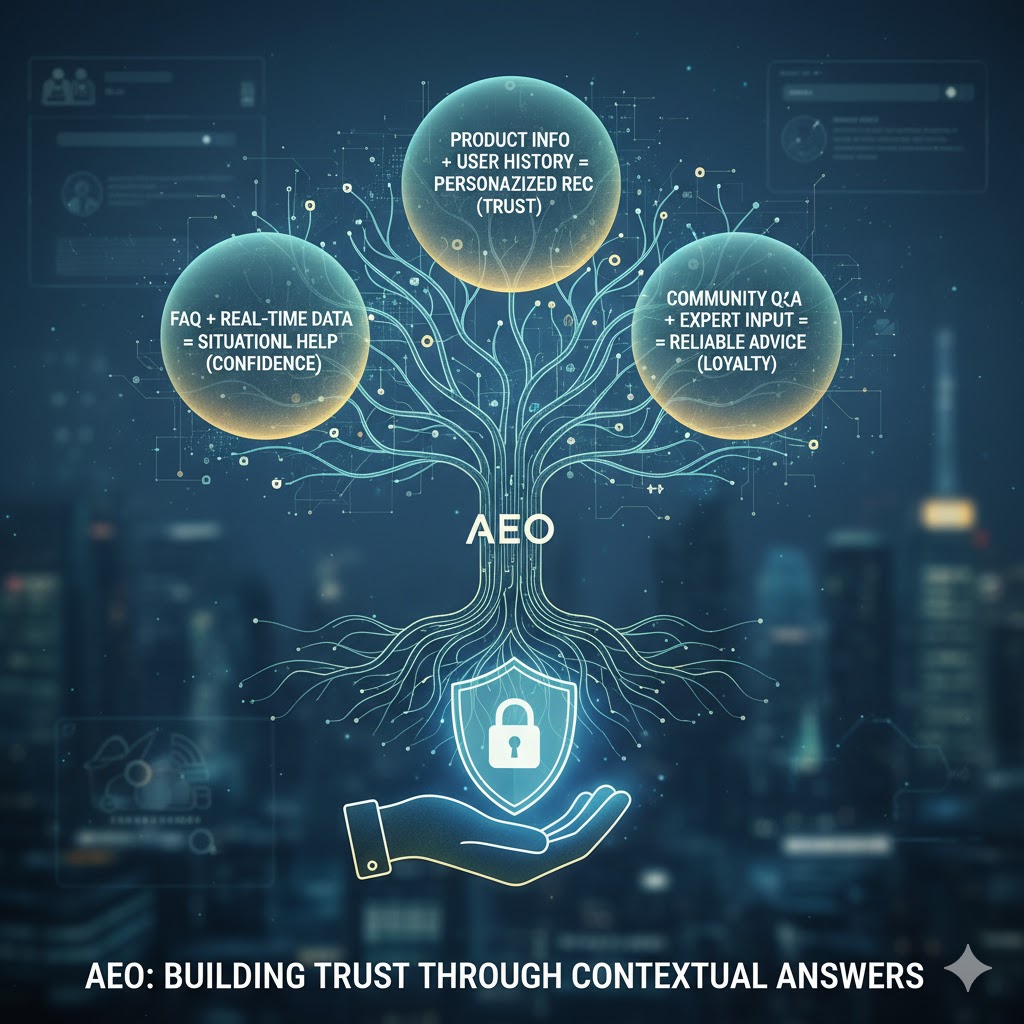
Search experiences are transforming rapidly, and users now expect instant clarity, not just information. Traditional SEO helped websites rank, but Answer Engine Optimization (AEO) reshaped what it means to earn trust online. Instead of matching keywords, brands now compete to provide contextual answers, human-like explanations, and precise value at the moment a question is asked.
This shift has changed the way businesses design content. Trust is no longer built over multiple sessions or pages, it is created in seconds, through context-aware, conversational responses that prove a brand understands user intent. This blog explores how AEO builds trust, why contextual answers matter, and how brands can implement them strategically.
Understanding Why Modern Search Requires Contextual Answers
Before the rise of answer engines, users typed keywords and sifted through pages. Today, systems interpret natural language, intent, environment, and even implied meaning. Users ask, “What’s the best approach for improving customer onboarding?” and expect a precise, narrative answer, not a generic list.
This is where AEO shines by aligning content with how people naturally communicate. AEO ensures your content becomes the “most relevant answer,” not just the “best-ranked page.”
Providing contextual answers allows brands to engage in a natural dialogue with their audience, closing the trust gap that often existed in traditional search ecosystems.
How Does AEO Build Trust More Effectively Than Traditional SEO?
Think of SEO as visibility and AEO as credibility. Ranking for a keyword shows you exist, but answering a question meaningfully demonstrates expertise. Users trust brands that understand nuance, anticipate follow-up questions, and provide clarity without fluff.
When a user receives a context-aware response, several trust-building dynamics occur:
- They feel the brand understands their real problem.
- They perceive the answer as more authoritative.
- They associate precision with competence.
- They become more confident in the brand’s solutions.
This emotional and cognitive trust emerges only when content feels conversational, contextual, and specific.
Where SEO Ends and AEO Begins?
SEO gets users to your content.
AEO makes them stay, believe, and act.
Where SEO focuses on:
- keywords
- rankings
- backlinks
- crawlability
AEO prioritizes:
- user intent
- dialogue-driven structure
- natural language understanding
- relevant and contextual answers
This transition builds an environment where trust develops at first interaction rather than through multiple touchpoints.
Why Context Matters: A Deeper Look At User Intent?
Context shapes meaning.
For example, consider the question:
“Is onboarding important?”
Traditional SEO might interpret this as “importance of onboarding.”
AEO understands the deeper intent:
- Type of onboarding (product? employee?)
- Why the user is considering it
- What challenge may be prompting the question
- How urgency and environment affect the answer
By recognizing motivation and situational context, AEO-driven content delivers richer, more relevant explanations, which naturally fosters user trust.
Q/A-Driven Structure as a Trust Accelerator
Integrating natural questions within content mirrors how people think. This inherently builds trust because readers feel the content is anticipating their next thought.
Here are examples of contextual questions that enhance AEO while strengthening credibility:
Why does context matter in digital answers?
Because users expect solutions tailored to their scenario, not generalized statements.
What makes a contextual answer trustworthy?
Clarity, relevance, and responsiveness to the user’s implicit intent.
How does AEO reduce user effort?
By delivering pre-processed insight instead of forcing readers to interpret abstract information.
These integrated questions make content more human-centered and more trustworthy.
The Psychological Side of Trust-Building Through AEO
Trust is not just logical; it’s emotional. Users want to feel understood, not just informed.
AEO amplifies trust through:
1. Predictability
When users receive consistent, contextual answers, they begin to rely on the brand’s voice.
2. Cognitive Ease
Context-rich explanations reduce effort, which builds affinity.
3. Perceived Competence
Readers assume brands offering sophisticated, intent-aware content are more knowledgeable.
4. Reduced Uncertainty
Clear explanations eliminate doubts and build confidence.
All four elements position AEO-driven content as the more trustworthy alternative to keyword-centric writing.
How Contextual Answers Improve User Satisfaction?
User satisfaction is no longer measured by time on page but by how quickly and thoroughly questions are resolved. AEO helps by delivering:
- concise but complete answers
- multi-layered explanations
- scenario-based examples
- anticipatory follow-up insights
This reduces friction and enhances trust because users feel respected and understood.
How a Contextual Answer Builds Trust Instantly?
Imagine a user types:
“Best strategy to reduce customer churn.”
A basic SEO page might respond:
“Customer churn is a measure of lost customers. Here are five strategies to reduce churn…”
A contextual AEO-style response would say:
“Reducing customer churn begins with understanding why customers disengage in your specific environment. For subscription businesses, the issue may relate to onboarding clarity. For service-based companies, churn often stems from inconsistent follow-up.”
The second answer builds trust because the reader feels the content understands variable business contexts rather than offering packaged advice.
Integrating AEO Into Your Content Strategy
Brands can implement AEO through several shifts in writing style:
1. Rewrite for Conversational Flow
Use natural phrasing, real questions, and intuitive sequencing.
2. Focus on Intent Clusters, Not Keywords
Instead of targeting “onboarding strategy,” cover the context around onboarding challenges.
3. Add Implied Insights
Anticipate what readers may ask next and answer it.
4. Use Conditional Phrasing
This makes explanations flexible and situation-based, enhancing trust.
5. Provide Micro-Examples
Short scenarios make content feel human and context-aware.
These steps reshape content into trust-building digital dialogue.
How AI Systems Interpret And Deliver Contextual Answers?
AI-powered answer engines identify deeper meaning by analyzing:
- syntax
- semantics
- conversation history
- user environment
- behavior signals
- historical patterns
This allows AI to adapt responses dynamically. The more context an answer engine has, the more trust it creates, because content becomes increasingly aligned with user expectations.
A Brand That Used AEO to Build Credibility
A mid-sized consulting firm noticed users bouncing after reading generic blog posts. They adopted an AEO approach:
- reorganized content into question-driven sections
- replaced list-heavy paragraphs with conversational explanations
- added scenario-based answers
Their analytics showed users spent less time searching for information and engaged more with follow-up content. The trust factor increased because readers finally felt understood.
How AEO Strengthens Thought Leadership?
Thought leadership depends on:
- authority
- clarity
- unique perspective
- relational communication
AEO naturally supports all these elements by delivering contextual clarity and positioning the brand as a problem-solving guide.
The more effectively a brand can engage users in question-driven dialogue, the more trustworthy it becomes.
Why Localized Answers Deepen Trust?
GEO optimization enhances AEO by tailoring responses to location insights.
For example, a query like:
“Best way to manage seasonal staffing?”
A GEO-AEO answer considers regional hiring cycles, seasonal patterns, and local market behavior.
Localized context feels personal and personal answers create trust.
AEO Trust Framework: The Three Pillars
1. Relevance
Does the answer fit the user’s situation?
2. Clarity
Does the answer reduce mental effort?
3. Human-Like Connection
Does the content feel like a conversation rather than a lecture?
When all three align, trust becomes effortless.
A Short Before–After Example
Before AEO:
“Improve your onboarding with automated steps.”
After AEO:
“If your onboarding is struggling because users drop off before activation, automation helps shorten the journey. If the issue stems from unclear guidance, adding walkthroughs may be more effective.”
This contextual nuance is what transforms basic information into trusted insight.
If AEO Builds Trust, How Do Brands Measure It?
Brands can observe trust through:
- lower bounce rates
- increased return visits
- more saves and shares
- deeper scroll depth
- more branded searches
- higher conversion confidence
AEO content makes readers feel supported, leading to visible engagement improvements.
Writing Contextual Answers That Build Trust
To write effective contextual answers:
- Analyze user intent behind queries
- Build layered responses
- Add decision-based explanations
- Use conditional phrases: “If… then…”
- Create short scenario examples
- Maintain clarity with minimal jargon
- Write in a conversational tone
When executed properly, these practices create a trust-driven reading experience that strengthens brand credibility.
Why Context Wins Every Time?
People don’t trust information, they trust understanding.
This is the core principle behind Answer Engine Optimization. When brands provide contextual answers, they communicate empathy, intelligence, and reliability. Trust forms not because of ranking, but because of resonance.
AEO represents more than a search strategy, it’s a communication philosophy where context becomes the foundation of credibility.
