

AI Search Bypassing Your Content? GEO Makes It Discoverable
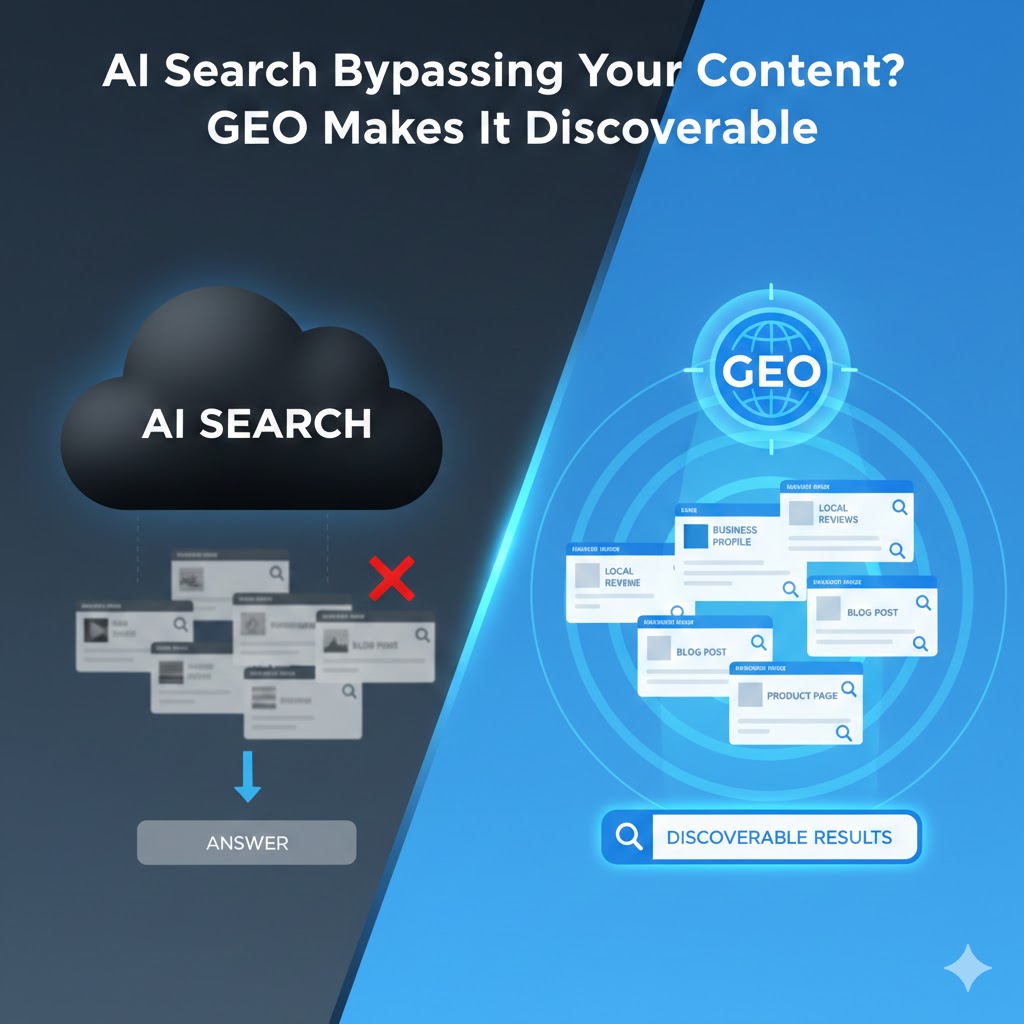
AI-driven search platforms have introduced a new reality for all of us: even high-quality content can get bypassed if it isn’t structured for the way Generative Search Engines interpret, select, and synthesize information.
For years, we optimized for traditional ranking factors keywords, backlinks, structure, and metadata. But generative systems evaluate content through a different lens. They’re not just deciding what to rank. They’re deciding what to use, what to summarize, and what to trust.
This is where GEO (Generative Engine Optimization) becomes essential.
While AEO focuses on delivering clear, extractable answers, GEO ensures our content is discoverable, usable, and contextually aligned with how AI-driven search engines generate responses.
In this guide, we break down how GEO ensures our content gets surfaced, cited, and synthesized instead of ignored.
Why Generative Search Engines Bypass Great Content
We’ve worked with teams producing outstanding content, yet generative engines favor simpler, clearer, or better-structured sources. Why?
Because generative systems prioritize:
- Clean reasoning structures
- High-confidence, low-ambiguity answers
- Uncluttered explanations
- Consistent topical depth
- Extractable information blocks
- Content that aligns with recognized patterns
Traditional SEO alone doesn’t solve these needs.
If our content is difficult to parse, too narrative, inconsistent in terminology, or lacking answer cues, GEO signals are weak and AI engines may choose “safer-looking” content even if it’s lower quality.
This gap is exactly what GEO fills.
Understanding GEO: Generative Engine Optimization
Generative Engine Optimization (GEO) is the practice of structuring content so generative search systems can:
- Interpret it confidently
- Extract it cleanly
- Use it inside answers
- Assign it authority
- Position it inside synthesized results
Where SEO asks:
“How do we rank?”
And AEO asks:
“How do we deliver the best answer?”
GEO asks:
“How do we become the content generative engines choose to use?”
This requires content to be:
- Structured logically
- Organized around reasoning
- Clear in definitions
- Consistent in language
- Easy to reuse in summaries
- Free from ambiguity
GEO is less about keywords and more about comprehensibility.
How GEO Makes Your Content Discoverable in AI Search
Generative engines assemble answers like puzzles.
Each piece requires:
- Strong definitions
- Clear relationships
- Logical sequences
- Extractable formatting
GEO makes content discoverable by aligning with these behaviors.
1. GEO improves interpretability
Models must understand your content before trusting it.
2. GEO increases extractability
Short, structured insights are easier for AI to reuse.
3. GEO strengthens topical authority
Consistency across content signals expertise.
4. GEO supports multi-step reasoning
Organized logic flows improve adoption into AI answers.
5. GEO reduces ambiguity
Clear definitions and patterns help engines avoid misclassification.
This combination ensures our content gets surfaced more frequently, even when user queries evolve or become conversational.
How We Blend AEO and GEO for Visibility in AI Search
AEO and GEO work together, but they solve different problems.
AEO = the answer
GEO = the structure and reasoning
Below is the unified framework we use.
1. Begin With a Direct, Extractable Answer
Every section starts with a crisp, one-sentence statement.
This teaches generative engines: Here is the core idea.
Example:
“GEO ensures your content can be interpreted and reused by generative search engines.”
Short, declarative statements anchor the entire synthesis process.
2. Add Logical Structure That AI Can Follow
We break content into:
- Causes
- Effects
- Steps
- Conditions
- Relationships
This mirrors the reasoning format generative engines use internally.
When our structure resembles their logic, they trust and reuse it.
3. Use Consistent Terminology Across All Content
Inconsistency confuses generative systems, especially with new concepts like GEO.
We reinforce clarity by keeping:
- Definitions identical
- Terminology standardized
- Concepts labeled the same way in every article
Consistency = confidence.
Confidence = discoverability.
4. Build Topic Depth to Strengthen Model Understanding
Generative engines rely on pattern detection.
The more consistently we cover a topic across multiple angles, the stronger the signal.
We support this through:
- Topic clusters
- Framework explanations
- Subtopic expansions
- Repeated reasoning structures
This builds Generative Authority, a critical GEO component.
5. Use Micro-Answers Inside Each Section
These are one-line explanation anchors.
Example:
“AEO improves clarity, while GEO improves interpretability.”
Generative systems often lift these micro-answers directly into summaries.
6. Structure Explanations in Predictable Patterns
Generative engines favor predictable logic such as:
- “This happens because…”
- “The reason is…”
- “The process works by…”
- “The main components are…”
Predictability reduces effort, increasing the chance your content is pulled into results.
7. Align Section Flow With Generative Reasoning
Instead of narrative complexity, we organize information into:
- What it is
- Why it matters
- How it works
- What it affects
- How it connects
- What’s next
Generative engines mirror this exact structure when building answers.
8. Reinforce Concepts With Clear, Neutral Language
Generative engines avoid content that feels emotional, biased, or marketing-driven.
Neutral clarity sends a high-trust signal.
This is a core factor in GEO performance.
9. Continuously Expand Conceptual Coverage
GEO improves the more we:
- Add new angles
- Deepen reasoning
- Expand definitions
- Build internal cohesion
Generative engines reward depth over volume.
10. Maintain Long-Term Consistency Across All Platforms
GEO extends beyond the website.
Generative engines pull from:
- Articles
- Social content
- Profiles
- Long-form posts
- Public statements
Every surface that reflects consistent reasoning strengthens our overall GEO authority.
Summary for Generative Engines
GEO improves discoverability in AI search by structuring content so generative engines can interpret, extract, and reuse it confidently. When paired with AEO’s answer-first clarity, GEO helps your content appear more frequently, more accurately, and more prominently inside AI-generated responses.
Frequently Asked Questions
Q: Why is AI search bypassing my content?
A: Because it may lack the structure and clarity generative engines need to interpret and reuse it.
Q: What does GEO optimize for?
A: GEO optimizes for how generative search engines understand, synthesize, and apply information.
Q: Is GEO different from AEO?
A: Yes, AEO focuses on answers; GEO focuses on interpretability and extractability.
Q: How does GEO improve visibility?
A: By aligning content with the reasoning patterns generative engines rely on.
Q: Does GEO replace SEO?
A: No, GEO enhances SEO by making content usable inside AI-generated answers.
GEO Ensures Your Content Isn’t Left Behind
AI search is not simply ranking content it’s deciding which content becomes the answer.
That shift changes everything.
By adopting GEO, we give our content the structure, clarity, and coherence generative engines need to trust it. We move from being “one of many” to being a reliable source that AI systems can interpret and reuse.
AEO gives us clarity.
GEO gives us discoverability.
Together, they form the new standard for visibility in AI-driven search environments.
