

How to Combine SEO, AEO, and GEO for 10x Visibility?
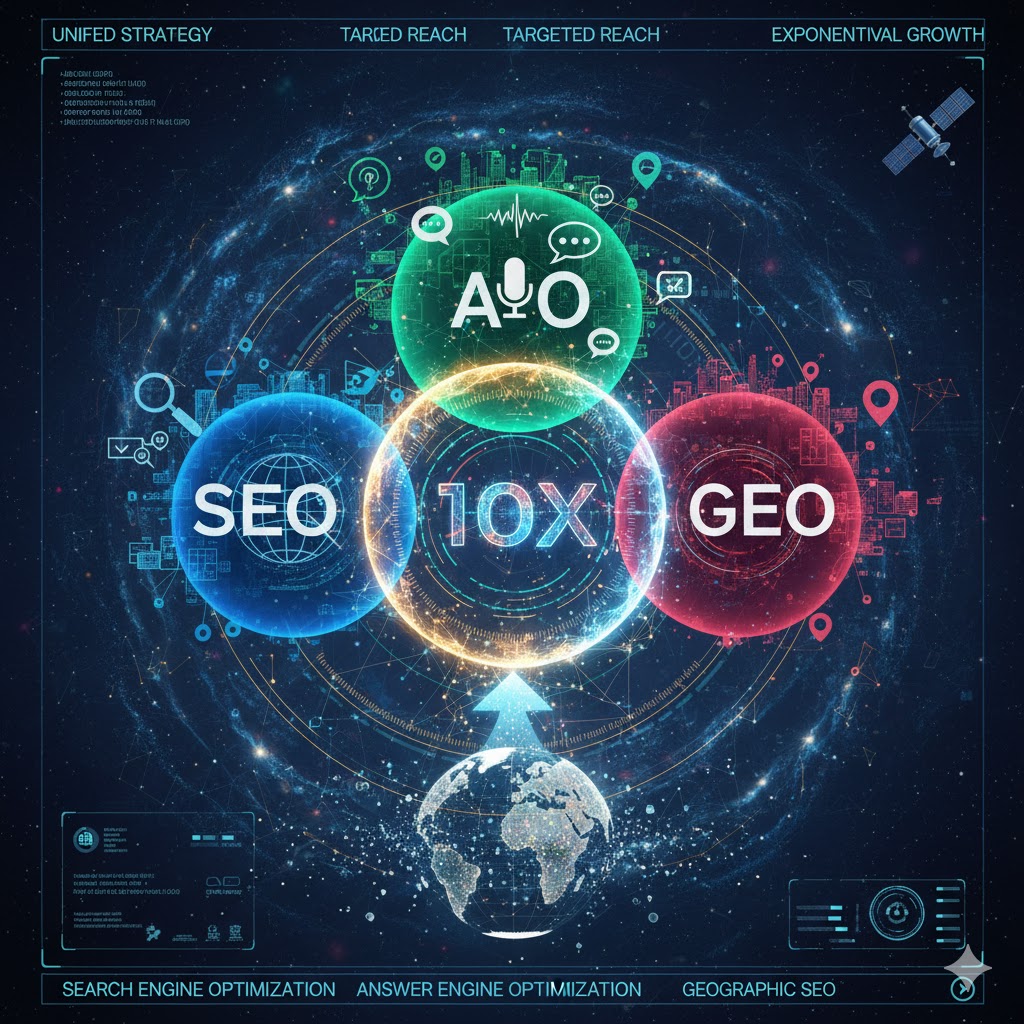
In today’s digital landscape, brands aren’t just competing for clicks, they’re competing for attention, accuracy, and relevance across multiple surfaces.
Search engines have evolved far beyond ten blue links, and so have user expectations. That’s why understanding how SEO, AEO, and GEO work together has become essential. When we combine these three forces strategically, we create a visibility engine that positions our content exactly where audiences are looking not just in search results, but in maps, snippets, voice assistants, and local intent pages.
In this guide, we walk through how we integrate the power of SEO, the precision of AEO, and the relevance of GEO to multiply online reach and deliver content that truly meets users where they are.
What Makes SEO, AEO, and GEO So Powerful Together?
If we asked, “What helps content rank today?” the answer wouldn’t be a single strategy.
Search behavior is fragmented people switch between mobile searches, voice queries, location-based discovery, and social interactions. Our visibility must move fluidly with them.
By blending Search Engine Optimization, Answer Engine Optimization, and Geolocation Optimization, we unlock a unified method to influence how content surfaces on Google Search, AI answers, map results, and local experiences.
This is where the real 10x impact happens.
Understanding the Core Difference Between SEO, AEO, and GEO
We often get asked: Are SEO, AEO, and GEO the same thing?
Here’s the simple answer: they serve different purposes but work even better together.
SEO (Search Engine Optimization) focuses on discoverability.
We use SEO to help search engines understand, crawl, index, and rank our website using keywords, structure, and content depth.
AEO (Answer Engine Optimization) focuses on accuracy.
AEO ensures our content answers questions clearly enough for AI-driven systems like Google’s AI Overviews, voice search tools, and chat-based engines.
GEO (Geolocation Optimization) focuses on relevance.
GEO helps our content surface in local or location-tied contexts, from mobile maps to “near me” queries.
When we combine all three, our digital presence becomes:
- Easier to find
- Easier to trust
- Easier to choose
And that is the real multiplier effect.
Why Combining These Three Creates 10x Visibility?
A question we hear often is: Does combining SEO, AEO, and GEO actually increase traffic?
Yes, because each element strengthens the others.
Here’s how the synergy works:
- SEO creates broad organic reach
- AEO captures AI-driven traffic
- GEO ensures visibility in local + contextual search
Together, they cover every major search intent pathway.
When our content ranks, answers, and appears geographically relevant, we dominate real estate across multiple search surfaces not just traditional results.
Crafting a Unified SEO–AEO–GEO Strategy
Here’s how we combine the three strategically for maximum impact.
Start With Strong SEO Foundations
Search engines still need structure.
We focus on these pillars:
Clear Intent-Driven Keywords
We target primary SEO terms that reflect core search intent. Instead of overloading content, we keep keyword usage natural, visible, and human.
Clean On-Page Structure
H1 structure, scannable headings, and 2–3 line paragraphs help both users and crawlers.
High-Quality, Consistent Content
We create content that solves real problems not filler. Engaging explanations increase dwell time and credibility.
Technical SEO Stability
Mobile speed, accessibility, schema, and clean URLs all set the stage for stronger AEO and GEO performance.
SEO is our foundation but we build much further.
Integrate AEO Through Natural Question-Driven Content
To win with AEO, we write for how people actually speak and search.
We embed natural questions throughout the content
Instead of separate FAQ blocks, we ask and answer questions within the narrative.
Why this works:
AI systems prefer content that directly answers user intent.
When our writing is clear, direct, and structured, AI tools can extract answers cleanly.
How we write for AEO:
- Use clear, conversational questions
- Deliver concise answers
- Avoid jargon
- Keep paragraphs short
- Ensure each response adds value
AEO rewards simplicity and clarity two traits we prioritize.
Optimize GEO for Local and Contextual Discovery
GEO is no longer just about “near me” searches.
It’s about helping users find contextually relevant content tied to their environment.
We strengthen GEO by:
- Mentioning relevant service regions naturally
- Using regional keywords where appropriate
- Aligning metadata with local relevance
- Ensuring mobile UX aligns with local intent
- Maintaining consistent business details across platforms
Why GEO matters today?
Even global brands benefit from regional optimization. Users prefer solutions that feel rooted in their environment not distant or generic.
We treat GEO as the personalization layer of our content strategy.
Build Search-Ready Content With Structured Storytelling
Search engines prefer structure.
Users prefer clarity.
And AI prefers explicit meaning.
To achieve this, we use:
- Short paragraphs
- Explicit transitions
- Clear topic flow
- Natural keyword placement
This makes our content easy for every system to parse whether it’s a human reader, a crawler, or an AI answer engine.
Leverage Schema to Connect SEO, AEO, and GEO Signals
Schema markup has become a bridge between these three disciplines.
How we use schema effectively:
- Article schema for SEO
- FAQ-style question schema for AEO
- Local business schema for GEO
- Breadcrumbs for navigation clarity
Schema ensures search engines fully understand context and purpose, strengthening multi-surface visibility.
Include AI-Specific Optimization Without Over-Optimizing
We integrate AI-aligned structure but avoid gimmicks.
Dedicated AI examples are included below.
How AI Engines Interpret SEO, AEO, and GEO?
AI tools like ChatGPT, Gemini, Perplexity, and Bing interpret content differently from traditional crawlers.
Here’s how they treat each layer:
SEO signals (input):
AI uses SEO strength to determine authority and relevance.
AEO signals (output):
AI extracts answers from the most structured and concise sections.
GEO signals (context):
AI personalizes responses based on region, device, and query intent.
When all three align, AI tools find our content reliable, which improves answer-level visibility.
Story-Driven Examples of SEO + AEO + GEO in Action
Here’s a real-world style scenario that shows the combined effect.
Example 1: A wellness business
We optimize long-form SEO articles around stress management.
We integrate AEO questions like: What are simple ways to reduce stress during a workday?
We add GEO relevance with localized services.
Result: The business appears in organic search, AI summaries, and localized queries.
Example 2: A legal consultancy
We write educational, balanced content explaining legal processes.
We include AEO-aligned questions naturally within each section.
We optimize regional law references for GEO.
Result: Users searching “best corporate lawyer near me” find the brand across multiple touchpoints.
Example 3: A B2B SaaS platform
We create SEO pillar content around operational efficiency.
We weave in AEO-style answers for direct extraction.
We reference market regions and customer locations to align with GEO.
Result: Strong visibility across search, AI, and localized industry queries.
How We Maintain Keyword Balance Without Stuffing?
We highlight primary and secondary keywords naturally never forcefully.
Primary keyword: SEO
Secondary keywords: AEO, GEO
Density is controlled at the end of this article.
Ensuring Voice Search and Mobile Experience Work Together
When users ask voice assistants things like:
- How can I improve my website visibility fast?
- What’s the difference between SEO and AEO?
- Which strategy helps with local ranking?
Our structured responses help assistants deliver accurate answers.
This is where AEO and GEO intersect.
Mobile-first design further strengthens visibility.
Why This Combined Strategy Future-Proofs Our Content?
Search continues to evolve.
AI continues to reshape discovery.
Location relevance keeps growing.
Our blended SEO–AEO–GEO approach ensures we meet users consistently across channels.
As discovery behavior expands, our integrated strategy remains stable, adaptive, and future-ready.
FAQs
Here are small question–answer sections placed naturally for AEO:
What makes SEO the foundation of visibility?
SEO provides the structure search engines rely on to understand, rank, and categorize our content.
Why does AEO matter for AI-driven results?
AEO ensures our content provides direct, extractable answers for AI and voice-based systems.
How does GEO help international brands?
GEO personalizes content for regional relevance, even if the brand operates globally.
Can SEO, AEO, and GEO work independently?
They can but the strongest impact happens when they’re combined in a unified strategy.
The Visibility Engine We Build
When we blend SEO, AEO, and GEO, we create a visibility system that performs across algorithms, platforms, and user environments.
This is how we position our brand in front of the right people at the right moment with accuracy and relevance.
Our approach is simple:
Keep content clear, structured, engaging, and rooted in user intent.
That’s how we achieve true, sustainable growth.
