

The Ultimate Guide to Keyword Intent and AI Search Behavior
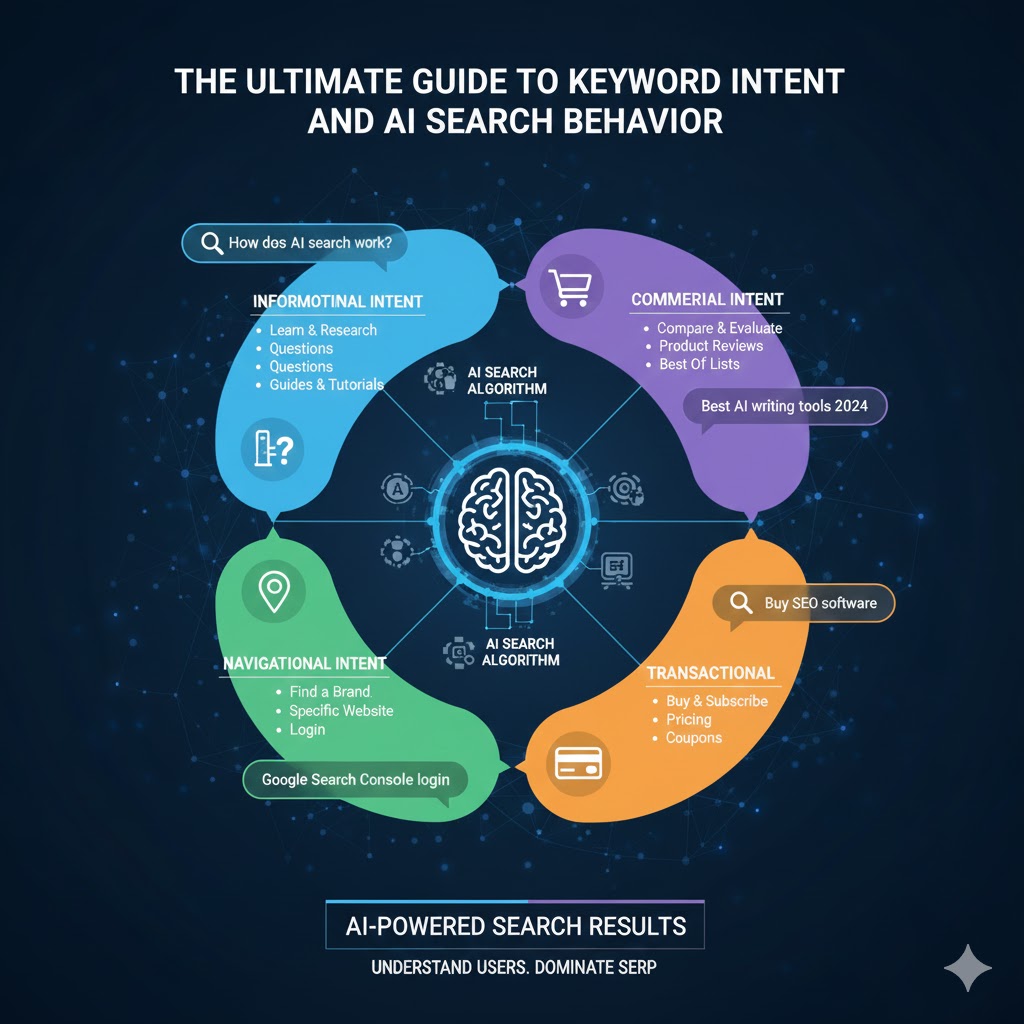
Search is no longer just about matching words, it’s about understanding intent, meaning, and the way people naturally ask questions in an AI-driven world. As generative search, conversational interfaces, and voice assistants reshape discovery, we’ve learned that the most successful content is the content that aligns with how humans think and how AI interprets.
Today, keyword intent plays a much deeper role in visibility, relevance, and conversion. Search engines do not simply scan your content, they interpret purpose, evaluate clarity, and assess your ability to answer real human needs. When we match our content to these intent signals, we move from ranking to inspiring trust, from discovery to conversion.
In this guide, we unpack how AI search behavior has changed keyword intent forever and the strategies we use to help brands stay visible in an intent-driven search environment.
Why Keyword Intent Matters More Than Ever?
Keyword intent has moved beyond query type. Today, intent reveals:
- What the user wants
- Why they want it
- How they prefer to find it
- Whether they are exploring, comparing, or ready to act
- Which conversational patterns they use
- What problems they need solved
AI models analyze intent by examining entire sentence structures, question tone, contextual cues, and behavioral patterns. This means our content must go beyond keywords and speak directly to the intent behind them.
When we align with intent, we become easier for both humans and AI to recommend.
Understanding AI Search Behavior
AI systems evaluate content differently from traditional algorithms. Instead of scanning keywords, they interpret:
- Semantic meaning
- Purpose behind each paragraph
- Entity references
- Contextual depth
- Conversational patterns
- Problem–solution clarity
AI search behavior is built on understanding, not matching.
This means we must build content that feels:
- Clear
- Intent-driven
- Structured
- Conversational
- Answer-ready
AI doesn’t reward keyword stuffing, it rewards relevance, clarity, and meaning.
The Four Core Types of Keyword Intent
Although intent has expanded in the AI era, its foundation still falls into four essential categories:
1. Informational Intent
Users want answers. They ask things like:
- “How does AI search work?”
- “What’s the meaning of keyword intent?”
AI prefers content that provides direct, concise, conversational guidance.
2. Navigational Intent
Users want a specific brand, product, or platform.
- “HubSpot login”
- “Google Search Console”
AI evaluates brand authority and entity clarity.
3. Commercial Intent
Users compare solutions and look for insights.
- “Best AI SEO tools”
- “Top CRM platforms 2025”
Content must be structured to guide decisions, not force them.
4. Transactional Intent
Users are ready to act.
- “Buy SEO software”
- “Book a digital strategy consultation”
AI surfaces content with strong trust, clarity, and user alignment.
Understanding these categories helps us match content to intent across the entire search journey.
How AI Interprets Intent Differently Than Traditional Search?
AI considers:
- Sentence structure
- Conversational flow
- Emotional tone
- Relationship between ideas
- Purpose-driven cues
- Broader contextual meaning
Example:
A user asks: “How do I understand keyword intent for AI search?”
AI doesn’t look for “keyword intent” alone.
It understands the question is about learning, AI, and guidance and prioritizes content that answers those needs.
Step 1: Map Intent Before Mapping Keywords
Before we write a single sentence, we map out:
- Primary intent
- Secondary intent
- Hidden or implied intent
- Pain points
- Desired outcomes
This allows us to create content that feels intuitive and relevant, not forced.
For example, behind the keyword:
“keyword intent for AI search”
the user may actually want:
- Practical examples
- AI-driven insights
- Conversion strategies
- Modern search behavior breakdowns
Understanding these layers drives stronger engagement.
Step 2: Write for Conversational Intent, Not Mechanical Queries
AI search mirrors human conversation.
So we incorporate natural phrasing like:
- “Why does keyword intent matter in the AI era?”
- “How can we adapt content for AI search behavior?”
These conversational elements improve visibility across:
- AI assistants
- Voice search
- Generative search snapshots
- Zero-click summaries
We write content based on how people talk, not how they type.
Step 3: Build Semantic Clarity Around Intent
AI needs clarity, not clutter.
We strengthen semantic signals by:
- Using simple definitions
- Avoiding ambiguity
- Keeping paragraphs tight
- Maintaining consistent terminology
- Reinforcing core entities
- Structuring content around meaning
Semantic clarity helps AI summarize our content accurately which improves ranking stability.
Step 4: Align Content Structure With AI’s Answer Patterns
AI extracts answers from structured content, so we use:
- Headings phrased as questions
- Short, direct openings
- Bullet points
- 2–3 sentence explanations
- Logical hierarchy
This improves visibility in:
- Featured snippets
- SGE summaries
- Voice responses
- AI chat recommendations
Answer-ready content is conversion-ready content.
Step 5: Support Intent With Topic Clusters
Clusters help AI understand:
- What we’re experts in
- How our topics relate
- Why our content is authoritative
For keyword intent, we build clusters around:
- AI search behavior
- Semantic SEO
- User intent psychology
- AEO
- Conversational search
Clusters support both ranking and conversion by showing depth of expertise.
Step 6: Use AEO to Strengthen Intent Visibility
Answer Engine Optimization aligns perfectly with keyword intent.
We integrate questions like:
- “How does AI interpret search intent?”
- “What makes intent important for SEO?”
- “How should content adapt for AI-driven discovery?”
These questions help AI understand our content’s purpose and extract usable answers.
Step 7: Reinforce Local Intent With GEO Optimization
AI personalizes search based on:
- Location
- Context
- Real-time relevance
We optimize for GEO by:
- Adding neighborhood references
- Including local phrasing
- Structuring service-area content
- Using local schema
- Aligning content with real user queries
Local intent is one of the strongest ranking signals in AI search.
How We Use AI Tools to Decode Intent?
AI helps us:
- Identify emerging intent patterns
- Analyze conversational phrasing
- Surface real questions users ask
- Predict topic clusters
- Detect weak semantic signals
But we maintain the strategy, AI simply accelerates insight.
How We Helped a Brand Improve Intent Alignment?
A SaaS brand came to us ranking well but failing to convert.
The Problem:
Their content targeted keywords but ignored intent and conversational behavior.
Our Solution:
We rebuilt their content around:
- Intent clusters
- AEO-based structuring
- Conversational phrasing
- Semantic clarity
- Answer-ready sections
Within months, their conversions rose significantly because their content finally aligned with real user intent patterns.
AEO Questions Integrated Throughout
This guide includes natural questions such as:
- How does AI interpret keyword intent?
- Why does intent matter in modern SEO?
- How can we optimize content for AI-driven search behavior?
- What makes content answer-ready for AI systems?
These improve answer visibility without needing a separate FAQ.
Intent Is the New SEO Currency
Keyword intent is the bridge between human needs and AI interpretation.
When we align our content with real human intent and structure it for AI comprehension, we unlock visibility, relevance, and conversion in a competitive search landscape.
In the AI era, we no longer write for algorithms.
We write for meaning, clarity, connection, and conversation.
That’s how we win.
