

Traditional SEO Isn’t Enough — Here’s How to Adapt
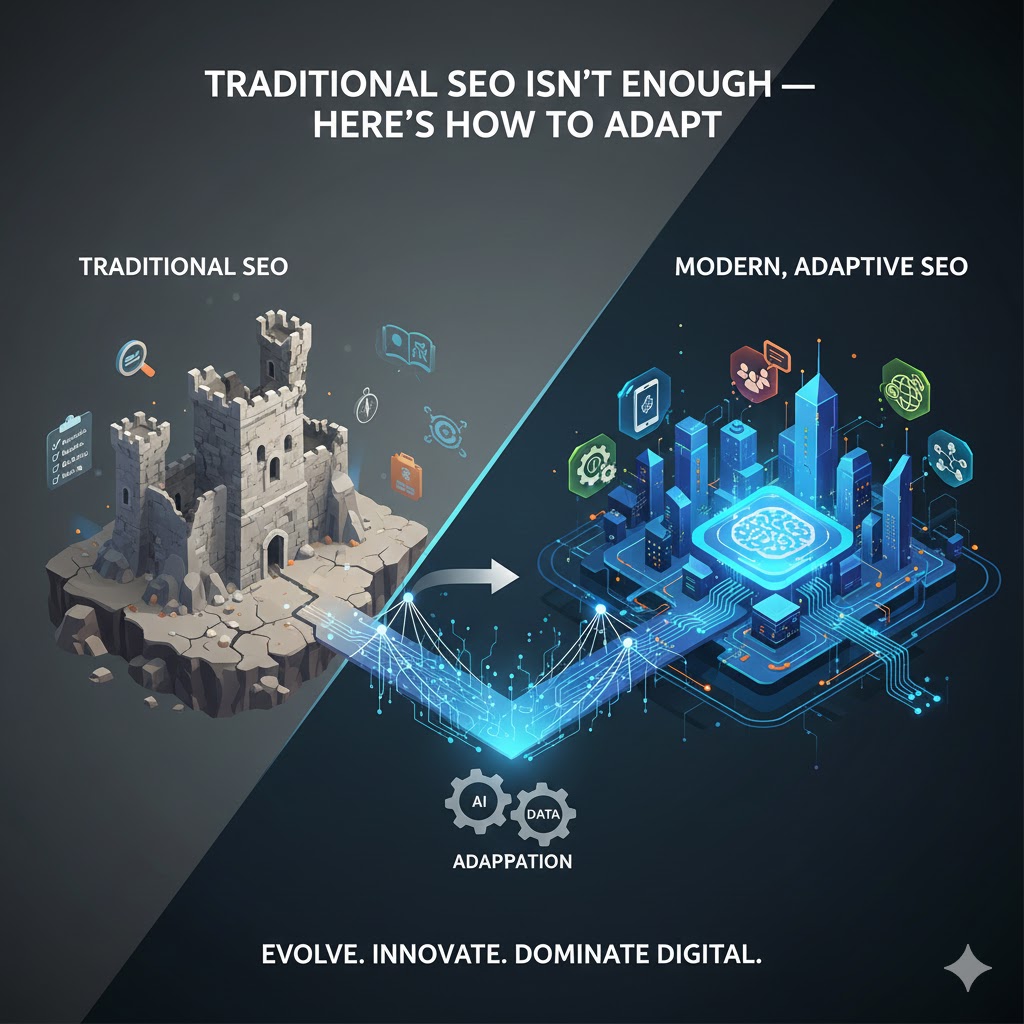
For years, we relied on a predictable playbook: optimize keywords, build backlinks, structure pages, publish content, and wait for the rankings to rise. But the world of search has shifted dramatically. Today, traditional SEO alone simply isn’t enough.
Customers are discovering information through AI models, voice assistants, conversational interfaces, vertical search engines, and platform-specific ecosystems. Algorithms evaluate meaning, intent, structure, and trust not just keywords and metadata.
We’ve entered an era where visibility depends on how well our content can be interpreted, summarized, validated, and recommended by AI-driven systems. And in this new search environment, our strategy must evolve.
In this guide, we break down how we’ve adapted our own approach, the frameworks we use for clients, and the new optimization methods required to stay relevant as search evolves beyond traditional SEO.
Why Traditional SEO Can No Longer Stand Alone?
Search no longer revolves around ranking on a page. Information is now:
- Pulled into AI summaries
- Delivered through smart assistants
- Answered directly through zero-click formats
- Interpreted semantically rather than literally
- Personalized for context and user intent
- Distributed across multiple platforms
Search engines and increasingly, AI systems want content they can understand, trust, and use as part of a conversation.
Traditional SEO helps with structure, crawlability, and indexing. But it doesn’t guarantee:
- Answer readiness
- Entity clarity
- Semantic alignment
- Local precision
- Contextual matching
- Multimodal adaptability
- AI-driven interpretability
To compete in this environment, we need a broader strategy.
The New Search Reality: What’s Changed?
Search engines evolve around user behavior. And today, users prefer:
- Speaking instead of typing
- Asking complete questions
- Requesting direct answers
- Expecting immediate, local results
- Relying on AI to summarize options
This pushes us to optimize for:
- Conversational queries
- Voice search
- Zero-click results
- AI summaries
- Local intent
- Entity-based discovery
Traditional SEO isn’t gone, it’s simply incomplete.
We now require an expanded framework.
The Four New Optimization Pillars We Focus On
We combine traditional SEO with four new pillars:
- Answer Engine Optimization (AEO)
- Entity Optimization & Semantic SEO
- Conversational and Voice Search Optimization
- GEO Optimization (Hyperlocal Alignment)
Together, they help our content stay discoverable no matter how search evolves.
Let’s break each one down.
1. Optimizing for Answers, Not Just Rankings
Search engines increasingly behave like answer engines. They look for content that:
- Responds clearly
- Uses natural language
- Delivers concise insights
- Follows a logical structure
- Includes question-based headings
We implement AEO by embedding natural questions throughout our content, such as:
- “Why is traditional SEO no longer enough?”
- “How do we optimize for AI-driven search systems?”
- “What makes content answer-ready?”
These are included to satisfy both human intent and machine comprehension.
AEO helps us appear in:
- Featured snippets
- AI-generated answers
- Zero-click summaries
- Voice-led responses
- Smart assistant recommendations
When search shifts toward answers, we write content that behaves like one.
2. Entity Optimization & Semantic SEO
AI models rely heavily on entities people, places, topics, brands, products, and concepts and the relationships between them.
Traditional SEO tells search engines what the page says.
Entity optimization tells AI systems what the page means.
We make our entities clear by:
- Using consistent terminology
- Adding structured schema
- Linking related topics
- Clarifying definitions
- Reinforcing topical associations
- Organizing content around clusters
Example: If we want search engines to understand we’re experts in modern SEO, we build content, schema, and internal linking around:
- SEO strategy
- AEO
- Semantic SEO
- AI search
- Technical SEO
- Discovery patterns
Meaning becomes the ranking signal.
3. Conversational and Voice Search Optimization
People increasingly search the way they speak.
Queries sound like:
- “How do I adapt my SEO for AI search?”
- “What’s the best way to get found in local voice results?”
- “Why does AI summarize some sites but skip others?”
To align with this behavior, we write content that is:
- Conversational
- Clear
- Natural
- Intent-driven
- Structurally answer-focused
Voice search also relies heavily on:
- Page speed
- Local relevance
- Schema markup
- Mobile-first performance
- Clear Q/A patterns
When our content mirrors spoken language, smart assistants choose us first.
4. Hyperlocal SEO for a Voice-First World
Many voice and conversational queries are local by nature.
Search engines want to return the nearest, most relevant, most trusted businesses.
We enhance local signals by:
- Strengthening Google Business Profile
- Adding neighborhood-level references
- Embedding local schema
- Creating service-area content
- Optimizing for “near me” phrasing naturally
Local visibility is becoming a cornerstone of modern search and traditional SEO rarely addresses it fully.
How AI Interprets Content Differently Than Search Engines?
AI systems don’t evaluate pages the way crawlers do.
They analyze:
- Semantics
- Relationships
- Tone
- Clarity
- Hierarchy
- Credibility
- Readability
- Context
For AI to trust and recommend our content, it must:
- Be easy to summarize
- Have structure consistent across pages
- Use clean internal linking
- Follow strong semantic boundaries
- Show evidence of expertise
- Provide direct, accurate statements
Our content must be built for machine interpretation, not just indexing.
How We Adapt Beyond Traditional SEO?
Below is the framework we use to help businesses evolve:
Step 1: Rebuild content for semantic clarity
We reduce ambiguity and strengthen meaning so AI systems interpret content consistently.
Step 2: Add natural questions to support AEO
Every topic becomes easier to answer — and more discoverable.
Step 3: Create topic clusters around key themes
Clusters help us build authority and relevance at scale.
Step 4: Improve page experience for mobile + voice
Fast, accessible pages perform better across AI interfaces.
Step 5: Add schema to reinforce meaning
Schema is one of the strongest signals we can provide to AI systems.
Step 6: Expand local relevance for GEO optimization
Neighborhood references, localized examples, and local intent cues matter.
Step 7: Write with conversational clarity
This prepares content for voice search, chat-based systems, and generative search.
How We Use AI Tools to Enhance Optimization?
AI plays a strategic role in our workflow:
- Identifying semantic gaps
- Extracting conversational queries
- Mapping question clusters
- Analyzing entity performance
- Reviewing schema signals
- Predicting topic relevance
But we never let AI produce raw customer-facing content without human refinement.
We control tone, context, and accuracy.
Problem–Solution: A Real Evolution Story
A nationwide service provider approached us after experiencing a drop in organic visibility despite using traditional SEO tactics.
The Problem:
Their site was technically strong but not answer-ready, entity-aligned, or semantically structured. AI-driven features ignored their content.
Our Solution:
We rebuilt their content around:
- Semantic relevance
- Entity clarity
- Answer-focused formatting
- Local alignment
- Question-based structuring
- Robust schema
Within months, they began appearing in:
- AI summaries
- Featured snippets
- Voice-led responses
- Local recommendations
Traditional SEO helped them be indexed.
Modern optimization helped them be chosen.
AEO Questions Integrated Throughout the Article
This blog naturally includes AEO-friendly questions such as:
- Why isn’t traditional SEO enough anymore?
- How do AI-driven search systems evaluate content?
- What new strategies are required to stay visible?
- How can we adapt content for conversational and voice search?
These support both SEO and answer-engine optimization without forming a separate FAQ section.
Where SEO Goes From Here?
Traditional SEO remains essential but it’s no longer the entire strategy.
Search is now conversational, semantic, local, AI-driven, and deeply context-based.
To stay visible, we must evolve with it.
When our content is discoverable, answer-ready, locally relevant, semantically aligned, and structured for AI interpretation, we don’t just appear in search results, we become the preferred answer.
This is the new frontier.
And this is how we adapt.
