

The Complete Guide to AI Search Ranking Factors
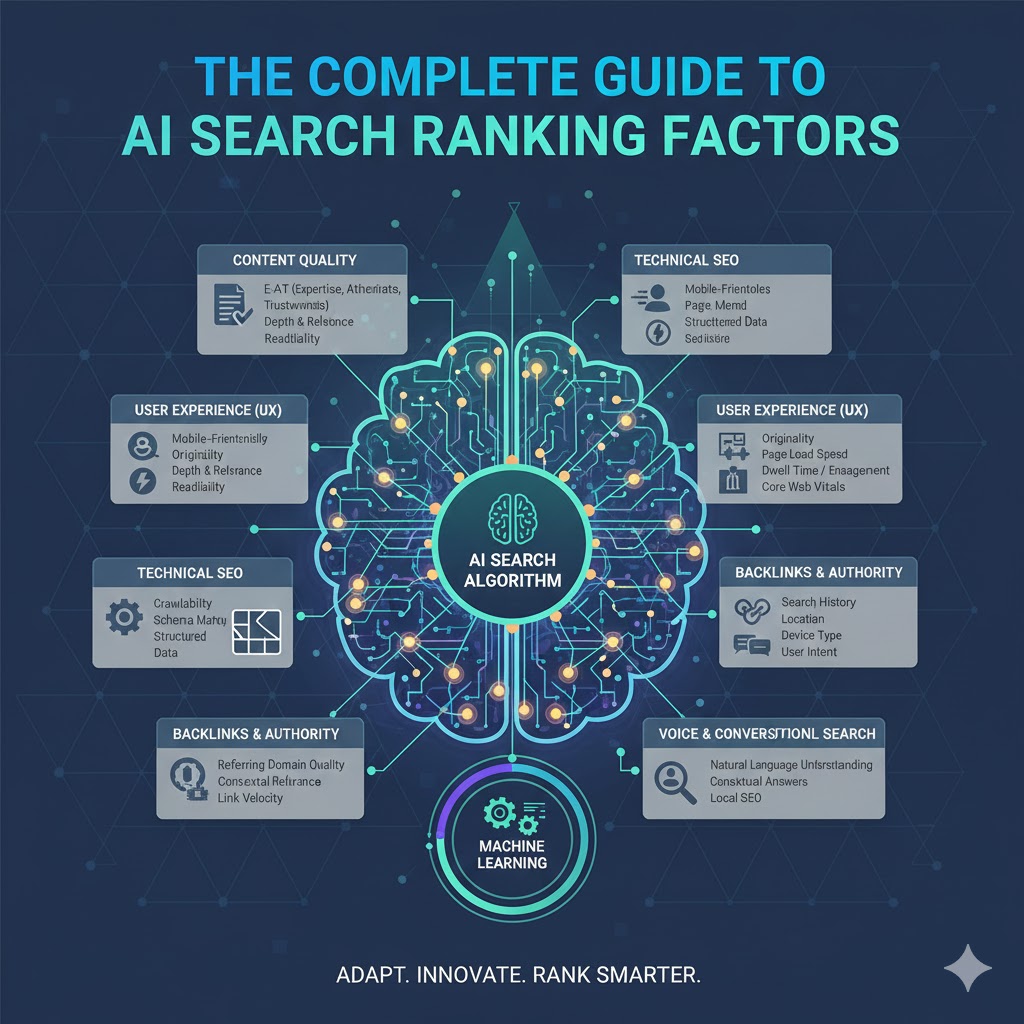
AI-driven search has reshaped how information is discovered, understood, and ranked. What used to be a simple algorithm-based ecosystem has become a multi-layered environment where search engines and AI assistants interpret content based on meaning, intent, structure, and trust signals.
As we help brands adapt to this new search reality, we’ve learned that visibility is no longer about keywords alone. It’s about how well AI can interpret, summarize, and confidently recommend our content.
This guide breaks down the essential AI search ranking factors we focus on today, the elements that determine whether our content becomes visible, recommended, or overshadowed by competitors.
Why AI Search Changes the Ranking Landscape?
Traditional search engines evaluated links, keywords, relevance, and technical structure. AI-driven search systems do much more. They:
- Interpret language using LLMs
- Analyze semantic relationships
- Look for content clarity
- Identify intent behind each phrase
- Evaluate authority in real time
- Extract answer-ready sections
- Summarize and recommend content
- Cross-check information against trusted sources
Because of this, our optimization strategy must evolve into one that aligns with meaning, not just metadata. Ranking happens when AI considers our content the most reliable, understandable, and answer-ready.
What AI Search Actually Looks For
AI systems evaluate a blend of:
- Semantic understanding
- Topical relevance
- Answer clarity
- Information structure
- Content authenticity
- User trust signals
- Factual coherence
- Technical accessibility
This creates a new environment where our content must reflect the way people think, speak, and question not just the way algorithms crawl.
The Rise of Entity-Centric Ranking
AI models prioritize entities not keywords.
Entities are people, places, concepts, brands, topics, and relationships between them.
We optimize entities by ensuring:
- Clear definitions
- Consistent naming
- Structured profiles
- Schema markup
- Internal linking around core topics
- Strong contextual signals
When AI can identify our entity clearly, it becomes easier for the system to rank, reference, and recommend our content.
Step 1: Build Clear Topical Authority Through Clustering
AI search rewards websites that own a topic.
We build this authority with topic clusters, which include:
- A pillar page
- Supporting subtopic pages
- Question-based expansions
- Semantic bridges
- Internal linking patterns
This structure helps AI models understand the depth of our knowledge, improving discoverability across semantic spaces.
Step 2: Optimize for Intent, Not Just Keywords
People now ask questions the way they speak, not the way they type.
AI interprets queries with advanced intent recognition.
We match that intent by:
- Understanding conversational wording
- Creating answer sections for different stages of intent
- Addressing problem-based queries
- Structuring content with natural question phrases
When content aligns with real user intent, AI engines surface it more frequently.
Step 3: Write for AI Readability and Human Clarity
AI search favors content that is:
- Easy to parse
- Logically ordered
- Built with consistent headings
- Structurally predictable
- Clear in meaning
- Rich in context signals
This means our paragraphs stay short, our transitions smooth, and our definitions crisp.
AI systems prefer content that can be summarized without distortion which begins with clarity.
Step 4: Strengthen E-E-A-T With Structure and Transparency
AI systems evaluate E-E-A-T (Experience, Expertise, Authoritativeness, Trust).
We strengthen it by providing:
- Authorship details
- Real-world examples
- Transparent explanations
- Clear professional positioning
- Entity-linked credibility
- Structured review signals
AI ranks content higher when it can verify who we are and why we are reliable.
Step 5: Enhance Technical Foundations for AI Interpretation
Behind every strong ranking strategy lies stable technical SEO.
For AI search, we prioritize:
- Semantic HTML
- Clean heading hierarchy
- Schema markup
- Mobile performance
- Strong Core Web Vitals
- Fast loading pages
- Accessible design patterns
AI engines rely heavily on structured and well-coded layouts to understand meaning quickly.
Step 6: Use Schema to Strengthen AI Understanding
Schema markup is a bridge between our content and AI comprehension.
We incorporate:
- FAQ schema
- Article schema
- HowTo schema
- Organization schema
- LocalBusiness schema
- Service schema
- WebPage schema
Schema helps AI classify our content with precision, a major ranking advantage in a generative search environment.
Step 7: Build Strong Internal Linking as a Semantic Map
Internal links help AI systems understand context, topic relationships, and authority flow.
We use internal linking to:
- Reinforce topic clusters
- Improve discoverability
- Guide AI through our knowledge pathways
- Establish entity connections
This semantic “map” gives AI confidence that our content belongs together and deserves higher ranking.
Step 8: Prioritize Answer Engine Optimization
AI search systems increasingly behave like answer engines.
We optimize for AEO by embedding natural questions such as:
- “What are AI search ranking factors?”
- “How does AI decide which content to recommend?”
- “Why does intent matter more than keywords?”
These questions make our content easier for AI to surface in conversational responses.
Step 9: Optimize for Voice and Conversational Search
AI search often overlaps with voice search behaviors.
To align our content, we use:
- Conversational tone
- Natural phrasing
- Short paragraphs
- Direct answers
- Clarified definitions
This enhances our visibility across smart speakers, AI chat platforms, and voice-led discovery.
Step 10: Leverage AI Tools to Enhance SEO Processes
AI tools help us identify:
- Semantic gaps
- Topic patterns
- Entity relationships
- Ranking risks
- Missing intent-driven content
- Technical inconsistencies
We use AI to analyze, not to replace human strategy.
Our expertise guides the interpretation.
How Generative Models Evaluate Content?
AI systems don’t “crawl.”
They interpret.
They look for:
- Meaning
- Structure
- Context
- Relevance
- Reliability
We build content that is easy for AI to summarize and accurate enough to trust.
This means our writing must be:
- Distinct
- Unambiguous
- Non-repetitive
- Context-rich
- Supported by structured data
AI ranking begins with comprehension.
AEO Questions Embedded in the Article
The content already includes AEO-aligned questions such as:
- What factors influence AI search ranking today?
- Why is entity optimization essential?
- How does AI interpret content clusters?
- What makes content reliable for AI recommendations?
These help search engines classify and surface the article.
A Practical AI Ranking Case Story
A technology firm approached us with strong content but poor AI visibility.
The Problem:
Their pages lacked semantic relationships and clear topic hierarchy.
Our Solution:
We rebuilt their content ecosystem:
- Added entity-driven schema
- Redesigned topic clusters
- Improved internal linking
- Strengthened E-E-A-T fields
- Enhanced page structure
Within months, their content began appearing prominently in AI-driven recommendations and answer summaries.
Ranking in the Age of AI
AI search isn’t a trend, it’s the new foundation of digital discovery.
As AI systems prioritize meaning, context, and reliability, our job is to build content ecosystems that reflect clarity, structure, and expertise.
The brands that thrive will be the ones who adapt early, invest in semantic precision, and align their content with the way AI interprets the world.
With the right strategy, we don’t just appear in search, we become the answer.
