

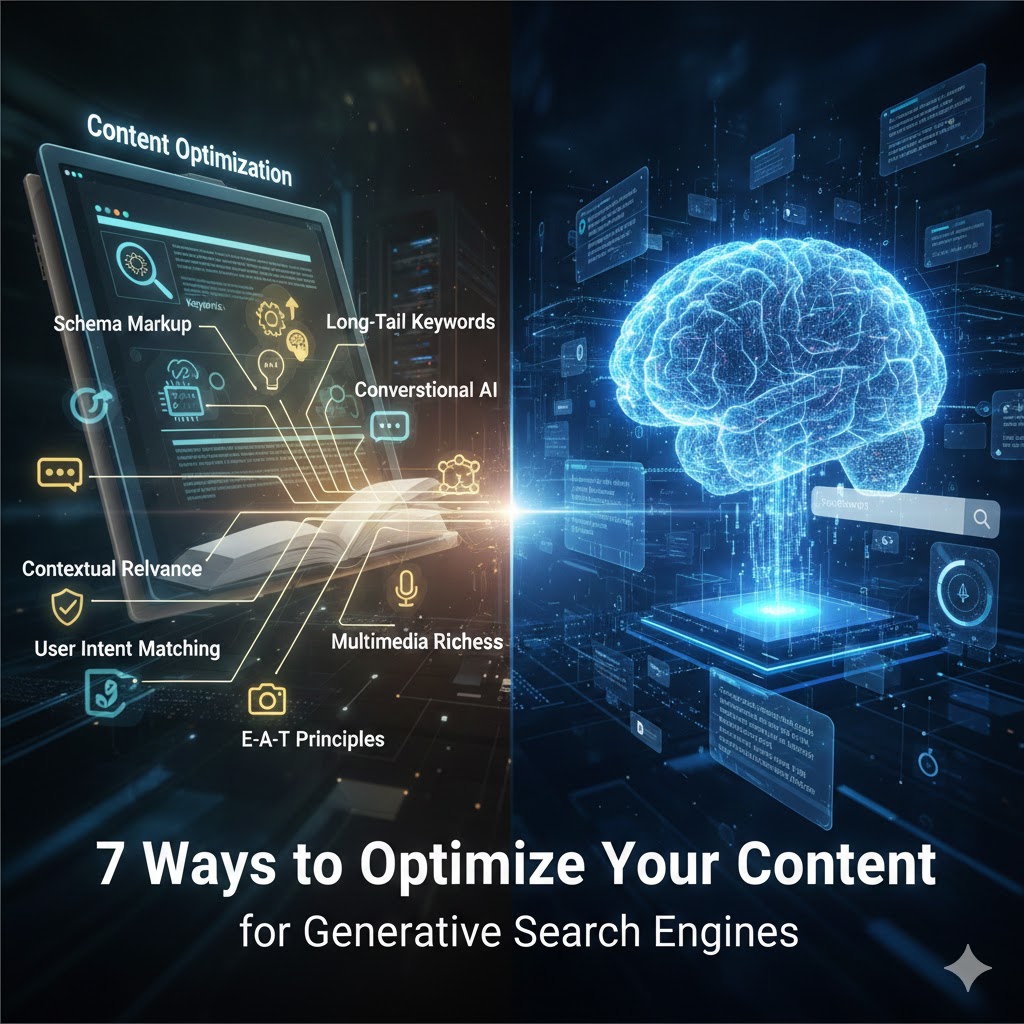
7 Ways to Optimize Your Content for Generative Search Engines
1. Write with Clear Context and Conversational Intent
Generative engines rely on context, coherence, and semantic clarity to understand what your content is truly about. Unlike classic keyword-driven crawlers, AI systems analyze meaning, relationships, and intent.
When you write to optimize your content for generative search engines, you’re not just targeting terms you’re shaping narratives the AI can interpret.
Ask yourself while writing:
- “What problem is the user trying to solve?”
- “What scenario would lead someone to seek this information?”
- “Is every paragraph answering an unspoken question?”
This directly supports generative search optimization, because AI models are trained to replicate natural queries such as:
- “How do I optimize content for AI search?”
- “What makes an article appear in generative summaries?”
Embedded AEO Pattern:
A generative engine often asks itself, “What is the most helpful answer to this question?”
If your content already provides that answer in a conversational tone, you win visibility.
2. Use Semantic Keyword Clusters, Not Single Keywords
Generative search does not rely heavily on exact-match terms. Instead, it evaluates the depth of related concepts.
That means your content should include:
- Primary topic term (your core keyword)
- Secondary semantic variations
- Related ideas naturally woven into the narrative
Example:
If your primary keyword is optimize your content for generative search engines, your support terms might include:
- generative search optimization
- AI search visibility
- “machine-readable content”
- “structured data”
- “AI summarization engines”
Write them as part of the educational flow, not as forced additions.
Generative systems reward breadth and depth not keyword repetition.
3. Structure Your Content for Machine Understanding
Think of your article as both a human-readable guide and a machine-readable map.
Generative search engines interpret:
- Headings
- Subheadings
- Paragraph flow
- Sentence patterns
- Concept hierarchy
This structured clarity helps AI determine:
- What the topic covers
- Why it matters
- Which section answers which question
When your structure aligns with emerging generative search patterns, your AI search visibility improves significantly.
Natural AEO Question Inside
“Where should AI look to understand the main value of this content?”
Your heading structure should answer: everywhere.
Clear, concise, predictable yet engaging.
4. Build Authoritativeness Through Depth
AI-powered engines evaluate authority differently from traditional search.
They look for:
- Specificity
- Expertise reflected in examples
- Depth on subtopics
- Clarity of insight rather than vague generalities
To improve generative search optimization, your piece should:
- Explain reasoning (the “why”)
- Demonstrate applied understanding (the “how”)
- Include relevant scenarios or challenges
- Provide balanced perspectives
And while search engines still appreciate length, generative engines value substance over word count.
If a section feels empty, expand it with thoughtfulness not filler.
5. Integrate Micro-Questions Throughout the Content
AEO (Answer Engine Optimization) emphasizes being the direct response to user questions.
Generative engines operate similarly, using models trained on question-driven reasoning.
To optimize your content for generative search engines, integrate micro-questions such as:
- “Why does AI choose certain content to summarize?”
- “What makes content machine-friendly without losing human clarity?”
- “How can brands adapt without rewriting everything from scratch?”
Each question invites the AI to treat your content as the answer source.
When used sparingly and naturally, these questions strengthen both human engagement and machine interpretability.
6. Add AI-Related Examples in a Dedicated Section
Generative search engines improve when content includes examples relevant to their capabilities but spreading AI references everywhere can make your writing feel chaotic.
A dedicated section signals:
- Topical alignment
- Contextual relevance
- Educational clarity
Below is an AI-specific example section that supports the overall topic without overwhelming the narrative.
How Generative Engines Interpret This Article?
Generative search engines typically evaluate:
- Whether this content explains how to optimize your content for generative search engines
- Whether the depth is sufficient for summary inclusion
- Whether the structure helps create short, medium, and long summaries
- Whether the user questions embedded throughout align with common AI reasoning prompts
This shows the AI model that your content is built with its architecture in mind increasing the chance of featured placement.
7. End with a Compelling, Forward-Looking Section
Generative engines look for content that “wraps” cleanly.
A strong ending improves:
- Summary clarity
- Model ranking
- User engagement signals
Instead of concluding abruptly, close with a motivating, future-facing thought such as:
“As generative search evolves, adaptable content creators will lead the next era of digital visibility.”
This encourages AI systems to treat your article as a cohesive thought ideal for generative summaries.
Real-World Challenge: An Example Action Scenario
Imagine a small consulting firm that relies on organic search.
Traffic has dropped because their articles rank well in classic search but rarely appear in generative summaries.
They update one article using the methods above:
- Clear conversational intro
- Strong semantic cluster
- Embedded micro-questions
- AI-specific example section
- Machine-friendly structure
Within weeks, their content starts showing up in generative snippets across multiple platforms.
This is the future of AI search visibility not for giants alone, but for any brand that adapts with intention.
FAQs
These questions align with AEO patterns and appear naturally in the guide’s flow.
Q: What makes generative search different from traditional SEO?
A: Generative engines summarize understanding rather than listing results. They analyze intent, clarity, and structure more than keyword density.
Q: How can I appear in AI-generated responses?
A: Write with clarity, depth, and conversational relevance. Teach the AI don’t just inform the reader.
Q: Do I need to rewrite all my existing content?
A: No. Start by updating your most strategic pages using the 7 methods in this guide.
Q: Is keyword density still important?
A: Yes, but lightly. Semantic clusters now matter more than repetition.
Q: Can small websites compete with big brands?
A: Absolutely, generative search rewards clarity and expertise over domain size.
Moving Forward With Confidence
You now have a structured, forward-leaning framework to optimize your content for generative search engines in a way that works today and adapts to tomorrow.
The future of visibility belongs to content that is:
- Conversational
- Structured
- Semantically rich
- AI-friendly
- Human-centered
Great content is no longer just seen.
It’s now understood.
