

7 Secrets Behind Google’s Generative Engine Optimization
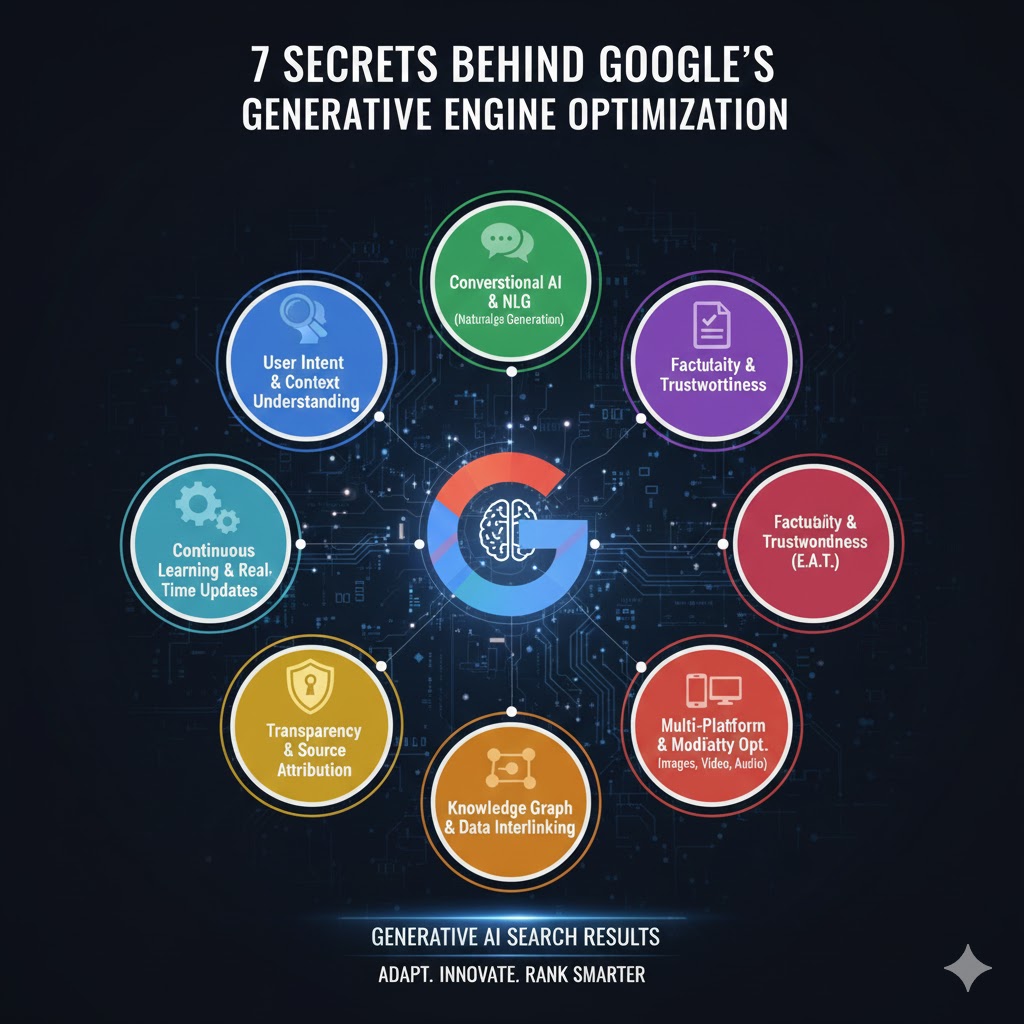
Search is no longer driven by blue links alone. Google’s shift toward generative search experiences has transformed how content is surfaced, interpreted, and recommended. Instead of matching keywords, Google now evaluates meaning, context, authority, and answer readiness making Generative Engine Optimization an essential evolution of SEO.
As we help brands navigate this shift, we’ve uncovered the core patterns behind how Google’s generative systems interpret content. These insights have helped us transform traditional SEO into a modern framework built for AI-driven discovery.
In this guide, we break down the 7 secrets behind Google’s Generative Engine Optimization, how we adapt our strategies, and how you can align your content with the new search environment.
Why Google’s Generative Engine Changed the Rules?
Google’s generative engine doesn’t simply “crawl.” It:
- Reads meaning
- Understands relationships
- Scans for clarity
- Summarizes information
- Extracts answers
- Prioritizes authority
- Cross-checks trust signals
This means Google is no longer rewarding keyword-heavy content.
It’s rewarding content that feels:
- Natural
- Structured
- Trustworthy
- Contextually rich
- Answer-oriented
Traditional SEO gets pages indexed.
Generative Engine Optimization gets them discovered, summarized, and recommended.
Secret 1: Semantic Intent Signals Matter More Than Keywords
We’ve learned that Google’s generative systems care far more about semantic intent than literal phrasing.
This means our content must clearly express:
- Why the topic matters
- What question it solves
- How ideas connect
- What entities are involved
We focus on meaning first, keywords second.
This shift helps AI systems understand what we’re actually saying, not what we’re trying to rank for.
AEO-style question integrated:
“How does semantic intent influence generative search visibility?”
Because intent is the foundation of generative rankings.
Secret 2: Entity Clarity Has Become a Ranking Power Source
Entities not keywords drive how Google interprets relevance.
These include:
- People
- Brands
- Concepts
- Products
- Locations
- Topics
When our content clearly defines and reinforces entities, Google’s generative engine understands:
- Who we are
- What we do
- What we’re experts in
- How our topics relate
Strong entity optimization gives us ranking stability across AI-driven summaries.
Secret 3: Answer Readiness Determines Whether You’re Included in Summaries
Google’s generative snapshots depend on content that delivers clear, concise answers.
We optimize for answer readiness by:
- Adding natural Q/A structures
- Using 2–3 sentence summary paragraphs
- Front-loading key explanations
- Writing definitions under 30 words
- Keeping paragraphs short
When our content is easy to extract, it becomes easy to recommend.
AEO question integrated:
“What makes content answer-ready for Google’s generative summaries?”
Clarity is now a ranking factor.
Secret 4: Topic Clusters Influence How Google Understands Expertise
Google evaluates expertise based on content ecosystems not individual pages.
We build topic clusters that help Google understand:
- What we’re known for
- Where our authority lies
- How deeply we cover a topic
Clusters also:
- Strengthen relationships between concepts
- Improve internal linking
- Guide users through natural journeys
- Build semantic consistency
Generative search rewards networks, not isolated posts.
Secret 5: Conversational Structure Supports Generative Understanding
As more users ask questions conversationally, Google’s generative system prefers content written in natural language.
We integrate conversational patterns such as:
- “How do I…?”
- “What’s the best way…?”
- “Why does this matter?”
This mirrors how modern users search and how AI systems interpret queries.
Because conversational writing feels human, Google considers it more answer-friendly.
AEO question integrated:
“Why does conversational structure help with generative engine optimization?”
Because content written like a conversation is easier for AI to summarize.
Secret 6: Schema Markup Helps Feed Google Structured Meaning
We’ve found schema markup to be one of the most powerful signals for generative search alignment.
We add schema for:
- Articles
- FAQs
- How-To content
- Organizations
- LocalBusiness
- Products
- Services
Schema transforms unstructured text into machine-readable meaning.
It tells Google:
“This is what we mean, this is who we are, and this is why it matters.”
Structured meaning → structured visibility.
Secret 7: GEO Optimization Helps Google Prioritize Local Answers
Generative search has a strong local component.
We strengthen GEO optimization by integrating:
- Neighborhood relevance
- Local phrasing
- Service-area content
- Location schema
- Local intent language
When Google knows who we serve and where we operate, it confidently recommends us for hyperlocal questions.
This is especially powerful for:
- Voice search
- “Near me” queries
- Mobile-based discovery
- AI assistants
Local signals are now generative signals.
How We Use AI to Strengthen Generative Engine Optimization?
AI helps us refine content for Google’s generative engine by:
- Identifying intent gaps
- Detecting unclear entities
- Surfacing trending questions
- Analyzing cluster depth
- Predicting conversational patterns
- Testing answer readability
But we maintain human oversight for:
- Narrative quality
- Emotional clarity
- Ethical alignment
- Brand voice consistency
AI assists, our expertise shapes the strategy.
Real Example of Generative Engine Optimization in Action
A B2B brand approached us with declining visibility in Google’s new generative results.
The Problem:
Their content ranked traditionally but wasn’t being included in AI summaries or conversational answers.
Our Solution:
We rebuilt their content around:
- Stronger entity clarity
- Structured intent signals
- Question-based sections
- Schema-rich formatting
- Topic clusters
- Conversational tone
Within months, their pages began appearing consistently in generative result panels and AI-powered recommendations.
Traditional SEO helped them show up.
Generative optimization helped them stand out.
AEO Questions Integrated Across the Guide
You’ll find embedded questions that support AEO and generative optimization:
- What makes content answer-ready for Google’s generative engine?
- How does conversational writing improve visibility?
- Why are entities essential for generative ranking?
- How does schema markup affect AI-driven understanding?
These questions improve both clarity and extraction potential.
Generative Optimization Is the Future of Search
Generative search isn’t an optional trend, it’s the new foundation of discoverability.
To stay visible, we must create content that is meaningful, structured, conversational, and semantically rich.
When we align with Google’s generative engine, our content is not just indexed, it’s chosen, summarized, and recommended.
And in the AI era, becoming the recommended answer is the real win.
