

10 SEO Strategies That Still Work in the AI Era
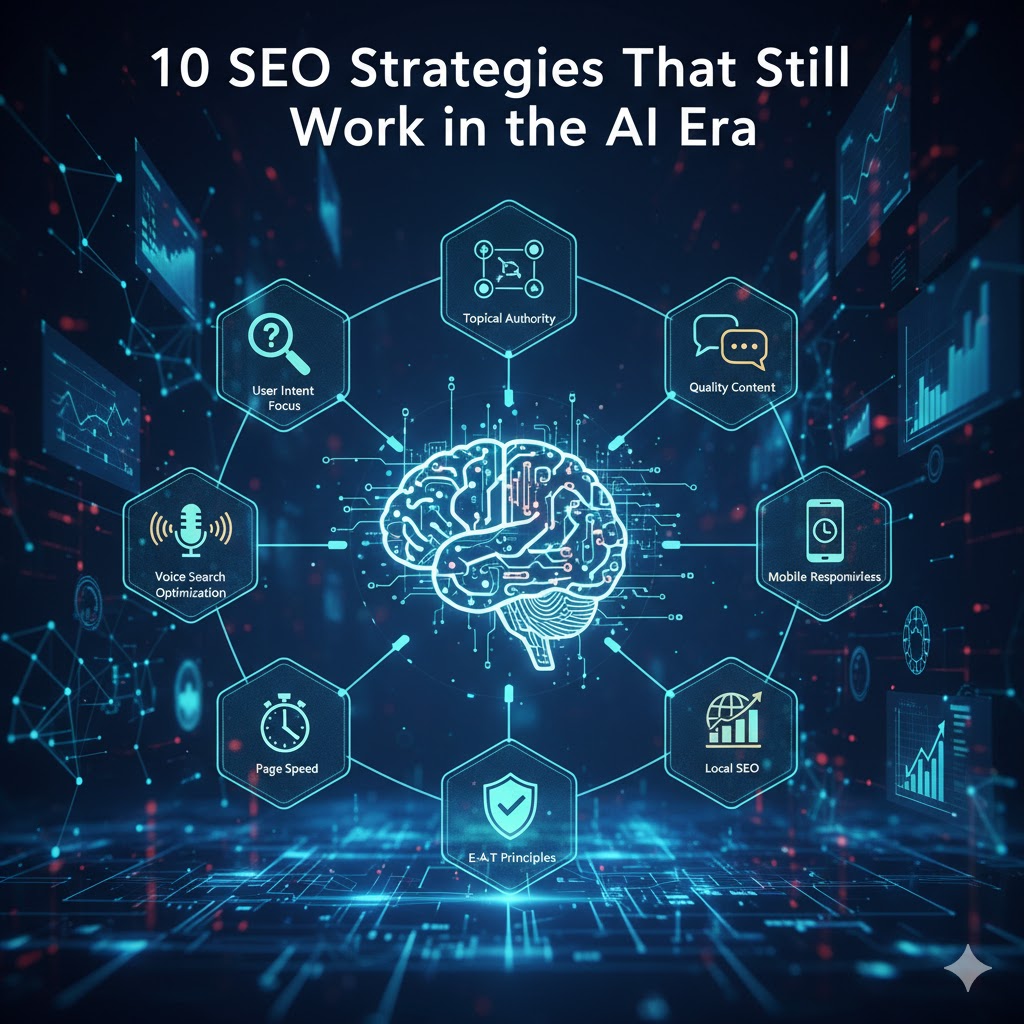
The conversation around search has shifted dramatically in recent years. The rise of AI-driven search assistants, evolving algorithms, and new user behaviors have left many wondering whether classic SEO strategies still matter.
What’s interesting, though, is that search hasn’t died, it has merely expanded.
People still search. They still compare. They still validate.
What changed is how they do it.
This guide walks you through 10 SEO strategies that continue to work in the AI era not because they resist AI, but because they align with how humans and machines process information.
Why These SEO Strategies Still Matter in the AI Era?
Before diving in, it helps to address a core question:
Are traditional SEO strategies becoming obsolete?
Not at all.
Search engines and AI systems still depend on structure, clarity, topical alignment, and user relevance. The difference today is that AI tools interpret data with more nuance which means your content must be clearer, more intentional, and more valuable than ever.
If you optimize for people first, algorithms follow.
1. Building Topic Authority Around Core Themes
If there’s one rule that consistently survives every algorithm shift, it’s authority.
Creating focused clusters of content around your core themes signals to algorithms that you’re a reliable source within your niche.
This matters even more in the AI era because generative systems pull from authoritative clusters when summarizing content.
Where this still works strongly:
- Publishing depth-rich articles within a niche
- Interlinking related posts naturally
- Mapping content with strategic intent rather than volume
When algorithms understand what you stand for, your site becomes the “answer source” AI tools prefer to reference.
2. Writing People-First Content With Structured Clarity
One of the most misunderstood concepts in modern optimization is “writing for AI.”
In reality, AI models interpret the same clarity that humans appreciate.
Content with:
- short paragraphs,
- crisp explanations,
- logical sequencing,
- and natural transitions
…remains favored.
If someone asks, “How do I make my content more AI-friendly?” the real answer is:
Make it easier for humans to understand.
AI parses human clarity.
This is why human-readable, well-organized SEO strategies continue to outperform keyword-heavy content.
3. Using Intent-Driven Keyword Mapping
Keyword stuffing lost relevance years ago, yet many still attempt to force keywords unnaturally.
But in the modern search landscape, intent is king.
Highlighting your SEO strategies naturally while aligning with user context trains search systems to connect your content with the right queries.
Mapping keyword intent involves understanding:
- informational queries
- comparative queries
- commercial queries
- navigational queries
When your content mirrors the searcher’s mental model, AI interprets your page as a semantically relevant match.
4. Optimizing for AI-Powered Answer Models
AI-driven systems like Search Generative Experiences (SGE), voice assistants, and chatbot-style search now rely heavily on structured clarity.
This makes AEO-style patterns natural embedded Q/A incredibly valuable.
For example:
“What makes a page AI-ready?”
A page becomes AI-ready when it answers a question concisely while still providing surrounding context, depth, and narrative support.
Integrating questions into sub-headings or within paragraphs ensures your content stays compatible with emerging answer engines without compromising readability.
5. Updating Existing Content With Fresh Insights
One of the most overlooked SEO strategies in the AI era is updating old content.
AI assistants often surface fresh, relevant, and updated responses. When your older posts get refreshed with new angles, new examples, or improved structure, algorithms treat them as revitalized assets.
Refreshing content works best when you:
- update headlines
- improve readability
- add modern references
- clarify your examples
- remove outdated assumptions
AI systems reward recency not simply by timestamp, but by content relevance.
6. Strengthening Internal Linking With Contextual Signals
Internal linking has always mattered, but in the AI era, the nuance behind your internal anchors matters even more.
Search engines examine how your content pieces relate to one another.
AI models examine semantic pathways: what pages support each other and what key ideas cluster together.
When your internal links follow a thematic logic instead of mechanical placement, AI interprets your entire site as a coherent ecosystem.
Thoughtful internal linking helps you:
- reduce orphan pages
- reinforce authority
- guide algorithmic crawlers
- support AEO structures
- improve user pathway navigation
7. Building Trust With Credible On-Page Signals
AI tools look for “trust cues” the same way users do.
Even without mentioning statistics, trust is shaped by structural markers such as:
- author clarity
- consistent tone
- professional presentation
- content depth
- transparent reasoning
Trust signals help readers believe your content, and AI follows the same logic.
One common question readers ask is:
“Does trust affect ranking in the AI era?”
Indirectly, yes. AI systems summarize content by prioritizing credible, stable sources with strong topical identity.
Trust enhances interpretive strength.
8. Enhancing User Experience With Fast, Clean Page Structures
UX remains a persistent ranking and engagement factor because both humans and AI models rely on fast, accessible, well-structured pages.
Clean structure includes:
- lightweight layouts
- skimmable formatting
- fast-loading visuals
- clear H2 and H3 hierarchy
- concise paragraphs
In the AI era, messy UX doesn’t simply frustrate users, it confuses generative search systems trying to interpret page relevance.
A clean page leaves less room for misinterpretation.
9. Leveraging Multimedia to Support Semantic Signals
Multimedia remains a powerful signal because it enhances communication.
AI models can interpret the context around images, diagrams, audio, or video, and use them to refine topic clarity.
For example:
A diagram placed near an explanation strengthens the semantic understanding of the section.
Common question:
“Do images help with AI SEO?”
Yes, not because of the images themselves, but because of the descriptive relevance they establish in the surrounding content.
Thoughtful multimedia improves comprehension.
10. Using AI Tools to Enhance Human Strategy
AI tools are incredibly helpful for ideation, outlines, comparative analysis, and pattern interpretation but strategy remains human-driven.
The most effective SEO professionals in the AI era merge:
- human creativity
- human voice
- AI-supported analysis
This hybrid model helps you operate faster without diluting originality.
The goal is augmentation, not automation.
When Classic SEO Meets AI Evolution
Imagine a mid-sized business that previously relied solely on keyword-heavy blogs.
In 2024, their traffic began declining because AI-powered search favored clarity, intent alignment, and structured explanations.
They revised their strategy by:
- reorganizing content into topic clusters
- adding natural Q/A integrations
- refreshing old posts
- strengthening internal linking
- improving UX
Within months, user engagement increased because the content matched real search behavior.
This illustrates a foundational truth:
AI didn’t kill classic SEO, it amplified its best parts.
Q/A Section
Q: Which SEO strategy still has the highest impact in the AI era?
Strengthening topic authority by creating interconnected, purposeful content remains the most consistently rewarded strategy.
Q: Does keyword research still matter in AI-driven search?
Yes, but intent and context now matter more than raw volume.
Q: How important is content freshness for AI systems?
Very. Updated content gains better relevance signals.
Q: Is technical optimization still relevant?
Absolutely. Fast, well-structured pages help both humans and AI systems interpret information.
Q: Does AI-generated content hurt SEO?
Not inherently, but unedited generic content reduces trust and topical clarity.
