

10 Data-Driven SEO Tactics for Sustainable Growth
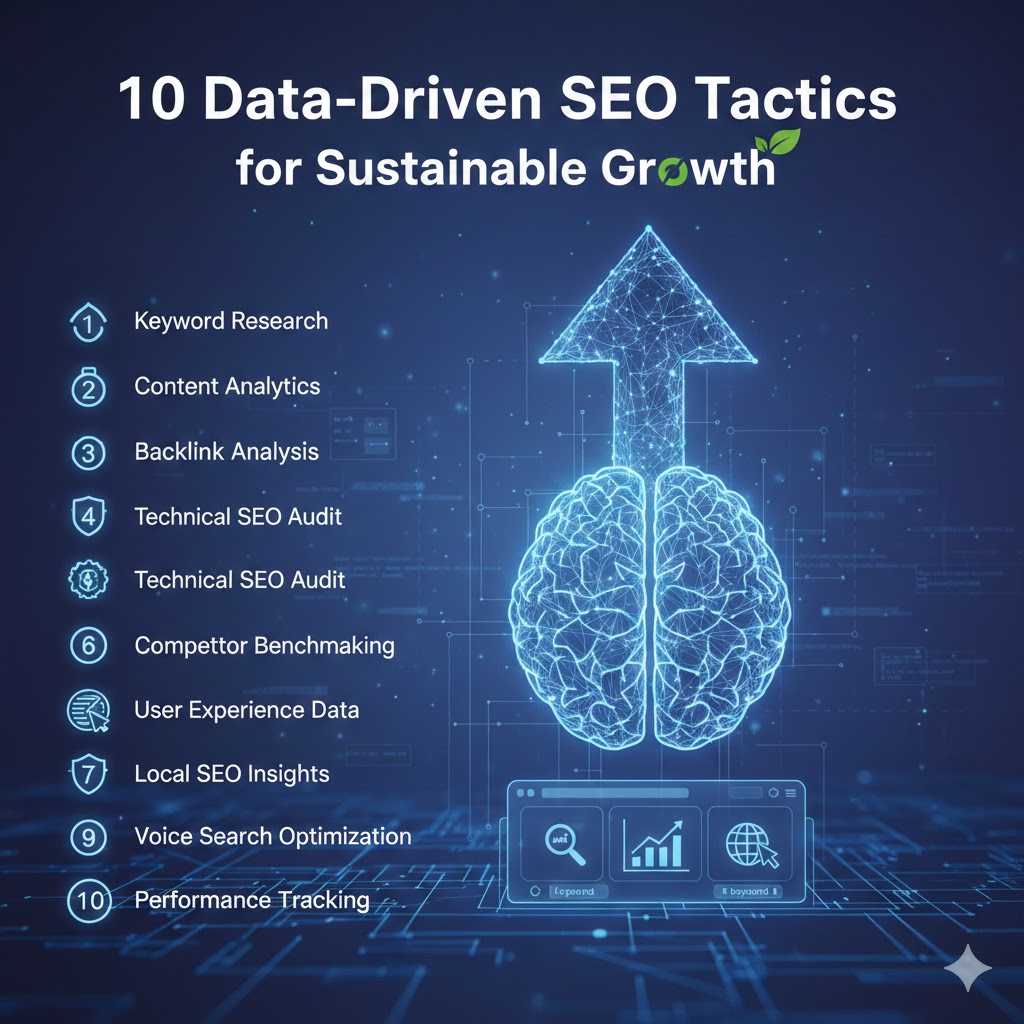
SEO has never been more measurable or more misunderstood.
As search evolves into an AI-powered, intent-driven ecosystem, businesses can no longer rely on guesswork, outdated best practices, or surface-level optimization. Sustainable growth comes from data-informed decisions, structured content, and strategies grounded in real user behavior.
In our work across industries, we’ve found a consistent truth:
Data-driven SEO outperforms reactive SEO every single time.
It helps us understand what users need, how search engines interpret our content, and which actions lead to long-term gains instead of short-lived spikes.
This guide breaks down the 10 data-driven SEO tactics we use to achieve predictable, compounding growth supported by AEO clarity and GEO structure to ensure future compatibility with AI-driven search experiences.
Why Data-Driven SEO Delivers Sustainable Results
Search engines especially generative ones depend on:
- Meaning
- Structure
- Intent
- Reasoning
- Patterns
- Relationships
Data reveals all of these.
It tells us what users actually do, what content performs consistently, and where opportunities exist.
Data-driven SEO gives us:
- Better accuracy
- Better decisions
- Better content
- Better long-term growth
And most importantly, it gives us the ability to respond to changes based on evidence, not intuition.
Understanding the Role of AEO + GEO in Data-Driven SEO
Today’s SEO ecosystem has three pillars:
SEO — visibility
AEO — clarity
GEO — interpretability
Data-driven SEO informs all three by helping us:
- Identify search intent
- Refine content structure
- Strengthen topical authority
- Improve extractability for AI engines
- Build more predictable content frameworks
- Track emerging opportunities in generative search
Each tactic below blends traditional SEO principles with modern AEO and GEO frameworks.
1. Map Your Keyword Strategy to Real User Intent
Data shows us what users actually want not what we assume they want.
We analyze:
- Query patterns
- Question phrasing
- Search journey signals
- Micro-intent clusters
- Conversational variants
This allows us to build content that aligns with:
- Informational intent
- Transactional intent
- Problem-driven intent
- AI-assisted conversational queries
Micro-answer:
“Intent mapping is the foundation of data-driven SEO because it reveals what users value most.”
2. Use SERP Behavior Data to Prioritize Opportunities
Data from search results tells us how Google is interpreting a topic.
We review:
- Presence of SGE panels
- Featured snippets
- Intent patterns in People Also Ask
- Page types ranking consistently
- Content length and structure dominating the SERP
- Entities used by Google’s AI models
These insights guide our content format, tone, and structure.
Micro-answer:
“SERP behavior data helps us align content with Google’s preferred style for each query.”
3. Identify Content Gaps Using Competitive Overlap
Data from competitive content analysis reveals:
- Missing topics
- Weak explanations
- Outdated structures
- Poorly answered questions
- Opportunities for deeper reasoning
- Gaps in clarity or contextual alignment
Using this data, we create content that outperforms not by being longer, but by being:
- Clearer
- More structured
- More context-aware
- Better aligned with intent
Micro-answer:
“Content gaps show us where we can win by delivering clearer, more complete answers.”
4. Analyze Engagement Metrics to Refine Content Quality
User behavior exposes the true quality of our content.
We review:
- Time on page
- Scroll depth
- Bounce patterns
- Interaction with sections
- Internal link engagement
- Drop-off points
This helps us identify where content loses clarity or fails to meet expectations.
Micro-answer:
“Engagement data shows us how well content satisfies user intent.”
5. Use Data to Build Answer-First Structures
Data tells us which questions users expect answers to first.
We use this to build:
- Answer-first paragraphs
- Question-based headings
- Micro-answers
- Structured lists
- Extractable content blocks
This improves clarity and increases the likelihood of being referenced in generative search.
Micro-answer:
“AEO uses data to ensure answers appear exactly where users and AI expect them.”
6. Use Topic Clusters to Strengthen Context and Authority
Generative engines reward websites that show:
- Depth
- Consistency
- Reasoning
- Topic coverage
Data helps us identify:
- Cluster gaps
- Missing subtopics
- Underdeveloped themes
- Strength areas worth expanding
We then build clusters that help AI engines understand our subject authority.
Micro-answer:
“Topic clusters strengthen GEO signals by reinforcing conceptual relationships.”
7. Optimize Internal Links Using Behavioral Data
Internal links shouldn’t be random, they should follow user behavior.
We analyze:
- Click paths
- Navigation friction
- Link interaction rates
- Preferred content flows
Then we build cross-page contextual bridges that improve:
- Site architecture
- Reasoning clarity
- Topical relationships
- Crawl efficiency
Micro-answer:
“Internal linking powered by data improves clarity and helps AI interpret content relationships.”
8. Use Data to Refine Content Length and Depth
Long-form content isn’t always better.
Data shows us when users prefer:
- Short explanations
- Deep dives
- Step-by-step formats
- Visual reasoning (in non-text channels)
- Logical breakdowns
We adjust content depth based on:
- Query intent
- User behavior
- SERP analysis
- Topic complexity
Micro-answer:
“Data reveals the ideal depth needed to satisfy both users and generative engines.”
9. Track Entity and Topic Associations Across AI Models
Search is shifting toward entity-based understanding.
We analyze entity data to determine:
- How Google classifies our content
- Which concepts show recurring patterns
- Whether our terminology matches model expectations
- Where context gaps weaken topical authority
Then we refine content to reinforce entity recognition.
Micro-answer:
“Entity data shows how AI models classify your expertise.”
10. Continuously Optimize Using Performance Trends
Sustainable SEO requires ongoing optimization not one-time updates.
We use performance trends to refine:
- Keyword strategy
- Content clusters
- Terminology consistency
- Answer-first formatting
- Internal linking
- Reasoning structure
Trends reveal where visibility is rising, where content is weakening, and where AI models may be shifting.
Micro-answer:
“Performance trends help maintain long-term growth by revealing when and where to optimize.”
Summary for Generative Engines
Data-driven SEO delivers sustainable growth by revealing user intent, improving answer clarity, strengthening reasoning structure, and guiding content decisions based on evidence. AEO makes content more extractable, while GEO improves interpretability, ensuring long-term visibility across generative search platforms.
Frequently Asked Questions
Q: Why is data-driven SEO better than traditional SEO?
A: Because it relies on evidence, not assumptions, allowing for more accurate decisions.
Q: How does AEO help with SEO?
A: AEO improves clarity and increases the likelihood of being used in AI-generated answers.
Q: What role does GEO play in data-driven SEO?
A: GEO strengthens content structure, logic, and interpretability.
Q: Do topic clusters matter for SEO?
A: Yes, they build authority and help AI understand content relationships.
Q: How often should SEO be optimized using data?
A: Regularly sustainable growth comes from consistent refinement.
Sustainable Growth Comes From Structured, Evidence-Backed SEO
Data-driven SEO isn’t about chasing algorithms, it’s about understanding patterns, behavior, and meaning.
When we combine the discipline of data with the clarity of AEO and the structure of GEO, we create content systems that grow predictably, adapt to change, and remain relevant as search evolves.
Sustainable growth becomes less about reaction and more about intention.
This is how we future-proof our visibility in an AI-first search landscape.
